
How do I know if my location is affected by grid congestion?
Direct answer
You check whether your location is affected by grid congestion via the national capacity map from Netbeheer Nederland and by contacting your regional grid operator. The map shows per area whether transport capacity is available for offtake and for feed-in. If the map shows limited capacity or a shortage with a waiting list for your area, or you are waiting for a new or heavier connection, you are almost certainly in a congestion area.
- Clear definition
- Data-driven assessment
- Risks and opportunities visible
- Practical next steps
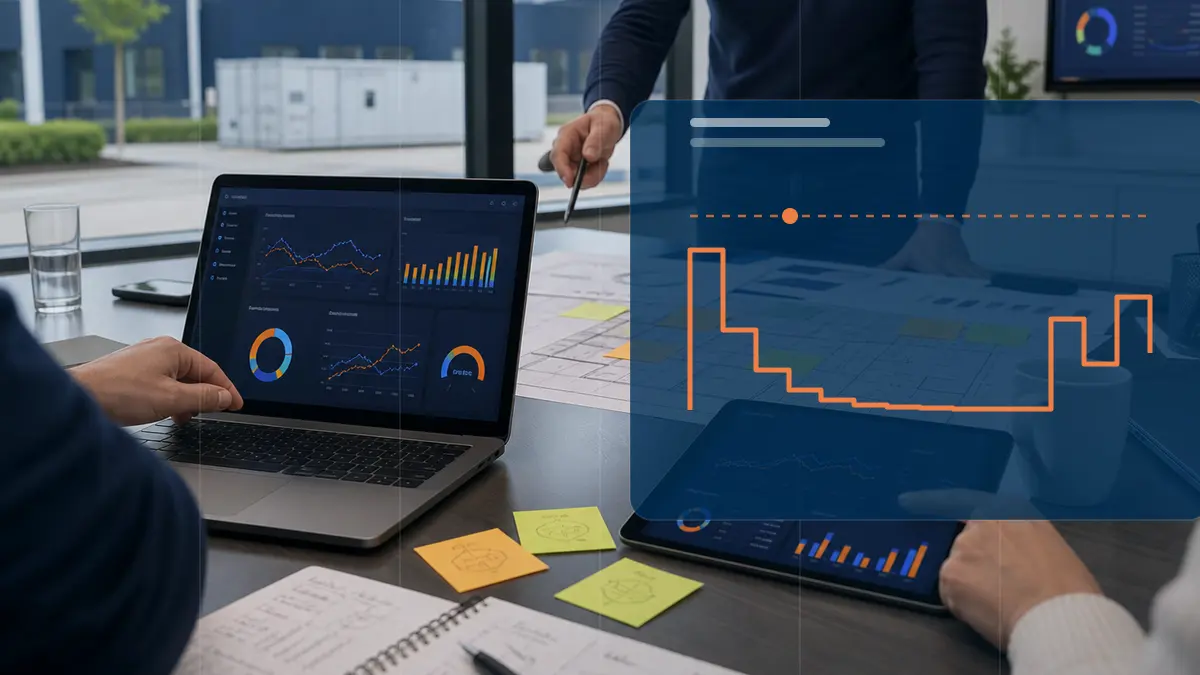
How do I know if my location is affected by grid congestion: scattered information versus Energy Intelligence
More and more business parks in the Netherlands face a full electricity grid. Companies that want to expand with an extra production line, charging points or solar panels often only hear at the application stage that the grid has no room. This happens, for example, to a logistics company that wants to electrify its fleet and then has to wait months or years for a heavier connection. By checking in advance whether your location lies in a congestion area, you prevent investment plans from stalling on a connection that never arrives.
- The capacity map at capaciteitskaart.netbeheernederland.nl shows available transport capacity per area, with separate views for offtake and for feed-in.
- Clear signs of grid congestion: a waiting list for a new or heavier connection, a rejected transport request or an announcement of congestion management in your region.
- Your regional grid operator can confirm on request the current situation for your specific connection and any position on the waiting list.
Insight
Traditional approach
Information is scattered across portals, documents, invoices or separate spreadsheets.
Modern approach
Data, context and interpretation are brought together into a clear decision picture.
Decision-making
Traditional approach
Choices are made based on averages, assumptions or occasional analyses.
Modern approach
Scenarios, KPIs and current measurement data make the trade-off more concrete and repeatable.
Follow-up
Traditional approach
Actions often stay non-committal or disappear into separate reports.
Modern approach
Follow-up actions, monitoring and reporting are linked to the same energy data.
Step 1: consult the capacity map from Netbeheer Nederland
Start with the national capacity map at capaciteitskaart.netbeheernederland.nl. This map from Netbeheer Nederland shows per area how much room the regional grid operators' electricity network has. First choose the right view: offtake if you want to consume power, feed-in if you want to inject power, for example from solar panels. The map currently works with four statuses, ranging from transport capacity available without a waiting list to a shortage of transport capacity with a waiting list. Note that the map is intended for large consumer connections. It makes no statement about small consumer connections. The map gives a first indication at area level, not a definitive answer for your specific connection. For that definitive answer you need step two.
- Choose the offtake view for consumption and the feed-in view for generation
- The statuses range from capacity available to a shortage with a waiting list
- The map is intended for large consumers, it says nothing about small users
- Zoom in on your own location to see the area of your connection
Step 2: recognise the signs and check with your grid operator
Beyond the map, there are clear signs that your location lies in a congestion area. Your grid operator rejects a transport request or places your application for a new or heavier connection on a waiting list. Or the operator announces that congestion management is being investigated or applied in your region. The distinction between two directions matters. With offtake congestion there is no room for extra consumption, for example for electrifying processes or charging infrastructure. With feed-in congestion there is no room to inject power, which mainly affects solar and wind projects. An area can face one of these or both at once. If in doubt, contact your regional grid operator. They can explain the current situation for your connection and any position on the waiting list.
- Waiting list for a new or heavier connection
- Rejection of a transport request by the grid operator
- Announcement of congestion management or a congestion study in your region
- Offtake congestion affects consumption, feed-in congestion affects generation
What can you do if your location lies in a congestion area?
Congestion does not mean nothing is possible any more. Start with insight into your own consumption profile: how high are your peaks, when do they occur and how much of your contracted capacity do you actually use. There is often still room within the existing contract. You can also deploy flexibility by shifting processes to quieter hours or letting a battery absorb peaks. In designated congestion areas you can take part in congestion management: you then agree with the grid operator to limit your peak load, for example through a capacity limitation contract, and receive compensation in return. Finally, you can explore an energy hub with neighbouring companies, in which businesses on a business park share connection capacity, generation and storage intelligently.
- Map your consumption profile and actual peak load
- Shift flexible processes to quieter hours or deploy storage
- Explore participation in congestion management with your grid operator
- Consider an energy hub with other companies on your site
Curious what this looks like with your own data?
In a no-obligation call, a specialist looks at your meters, sites and energy questions with you. Response within one business day.
Search the knowledge base
Find the answer to your question.
Search using your own words. Abbreviations and spelling variants are recognised, so EMS also finds the articles on energy management systems.
Topic