
Market dynamics
Article 8 of 20 · Energy markets and market dynamicsIntraday trading: a guide for businesses
Direct answer
Intraday trading is the continuous trading of electricity on the day of delivery itself, right up to just before the moment of delivery. Where the day-ahead auction sets the price the day before, intraday trading lets parties adjust their position as soon as new information arrives. It works through a continuous order book: buy and sell orders are matched as soon as price and volume align.
- Clear definition
- Data-driven assessment
- Risks and opportunities visible
- Practical next steps
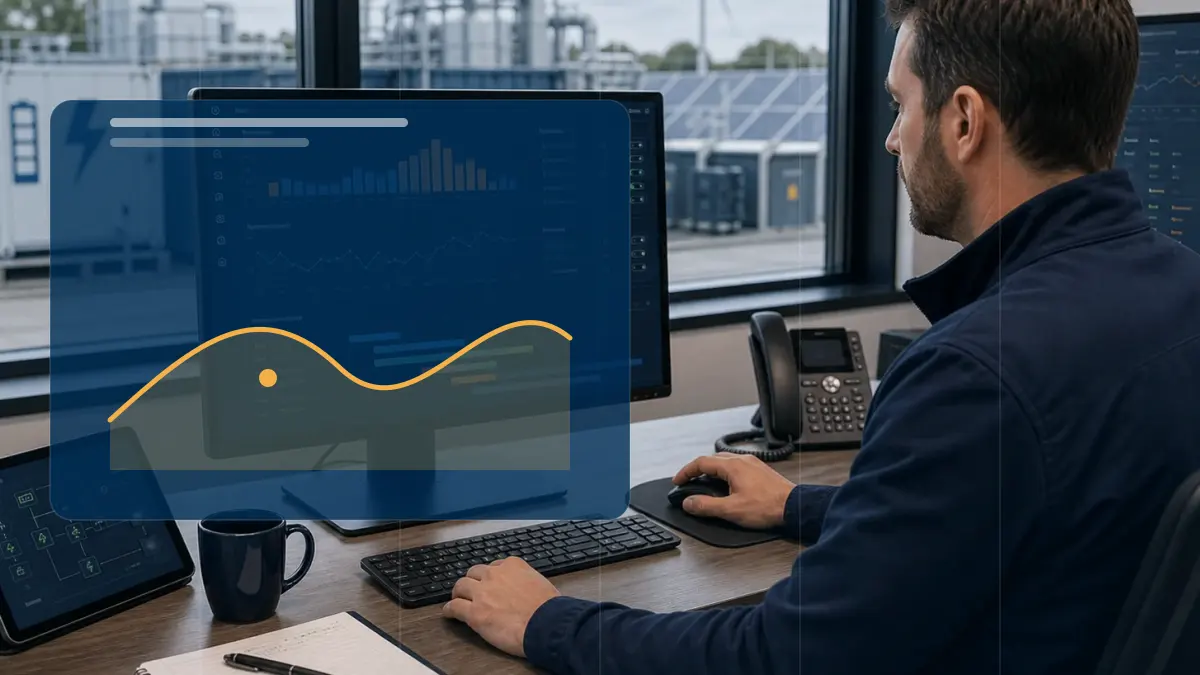
Intraday trading: scattered information versus Energy Intelligence
Electricity is not bought at one single moment, but in successive markets that lie ever closer to delivery. After the day-ahead auction a plan rarely holds exactly: the sun shines harder than expected, an installation fails, or consumption turns out differently. The intraday market exists to absorb those deviations while the day is running. It matters to any party that supplies or consumes power and does not want to end up short or long against its own plan.
- On the intraday market you trade continuously, not in a single auction; an order executes as soon as a counterparty matches.
- In the Netherlands trading within your own market zone runs until roughly five minutes before the moment of delivery; cross-border matching stops earlier, about an hour before delivery.
- The price moves during the day with new information, such as revised weather forecasts, a power plant outage or deviating consumption.
Insight
Traditional approach
Information is scattered across portals, documents, invoices or separate spreadsheets.
Modern approach
Data, context and interpretation are brought together into a clear decision picture.
Decision-making
Traditional approach
Choices are made based on averages, assumptions or occasional analyses.
Modern approach
Scenarios, KPIs and current measurement data make the trade-off more concrete and repeatable.
Follow-up
Traditional approach
Actions often stay non-committal or disappear into separate reports.
Modern approach
Follow-up actions, monitoring and reporting are linked to the same energy data.
How does intraday trading work?
Intraday trading runs through a continuous order book, not through an auction. Participants continuously place buy and sell orders for a specific delivery block, for example an hour or a quarter of an hour. As soon as a buy and a sell order align in price and volume, a trade is created directly. Each delivery block has its own order book. Trading stays open until shortly before delivery: within your own market zone the order book in the Netherlands only closes about five minutes before the moment of delivery. This lets you adjust right up to the actual delivery. In Europe these order books are coupled across borders, so an order from one country can match with one from another as long as transmission capacity is available. Cross-border matching does stop earlier than domestic trading, about an hour before delivery.
- Continuous order book: a trade is created as soon as two orders match, not at one fixed auction moment.
- Each delivery block, such as an hour or a quarter of an hour, has a separate order book.
- Within your own market zone the order book in the Netherlands only closes about five minutes before delivery.
- The order books are coupled across Europe; cross-border matching stops about an hour before delivery, as long as transmission capacity is available.
Why do parties use the intraday market?
After the day-ahead auction, reality keeps changing. A more accurate weather forecast shifts the expected output from solar and wind, a power plant fails unexpectedly, or consumption deviates from the forecast. Anyone who does not adjust their position ends up short or long and lands in imbalance towards the grid operator. On the intraday market you buy or sell the difference before the moment of delivery arrives. That is the first reason: avoiding imbalance. The second reason is capturing opportunities. Because the price moves during the day on new information, a party with controllable capacity can respond to high or low prices. The intraday price can differ sharply from the day-ahead price, precisely because it processes fresh information.
- Avoiding imbalance: buying or selling the difference from the day-ahead plan before delivery.
- Responding to new information such as weather, outages and consumption deviations.
- Capturing opportunities with controllable capacity as the price moves within the day.
- The intraday price can differ from the day-ahead price, because it processes fresh information.
What does a business with flexibility gain from it?
If you have consumption you can shift or capacity you can control, such as a battery, a cold store or a process that can wait a while, then intraday trading is a place to monetise that flexibility. You shift consumption to moments with a low intraday price, or supply capacity back when the price is high. The limits are real, though. Intraday requires speed: the price moves continuously and the order book closes just before delivery, so you have to decide and act quickly. Direct access to the trading platforms is moreover reserved for admitted trading parties. Most businesses therefore do not take part themselves, but use their flexibility through an energy supplier or an aggregator that trades on the market on their behalf.
- Shiftable consumption or controllable capacity can be deployed on the intraday market.
- Shift consumption to cheap moments or supply capacity at high prices.
- Limit 1: intraday requires speed, because the price moves and the order book closes late.
- Limit 2: direct market access runs through a trader or aggregator, not directly.
Curious what this looks like with your own data?
In a no-obligation call, a specialist looks at your meters, sites and energy questions with you. Response within one business day.
Search the knowledge base
Find the answer to your question.
Search using your own words. Abbreviations and spelling variants are recognised, so EMS also finds the articles on energy management systems.
Topic