
Market dynamics
Article 3 of 20 · Energy markets and market dynamicsICE ENDEX explained for businesses
Direct answer
ICE ENDEX is the energy exchange for forward trading in gas and electricity in North West Europe, home to the Dutch TTF gas contract that serves as a leading reference price. On ICE ENDEX, parties trade futures: contracts for delivery in a future month, quarter or year. This lets companies and energy suppliers lock in an energy price for a longer period in advance.
- Clear definition
- Data-driven assessment
- Risks and opportunities visible
- Practical next steps
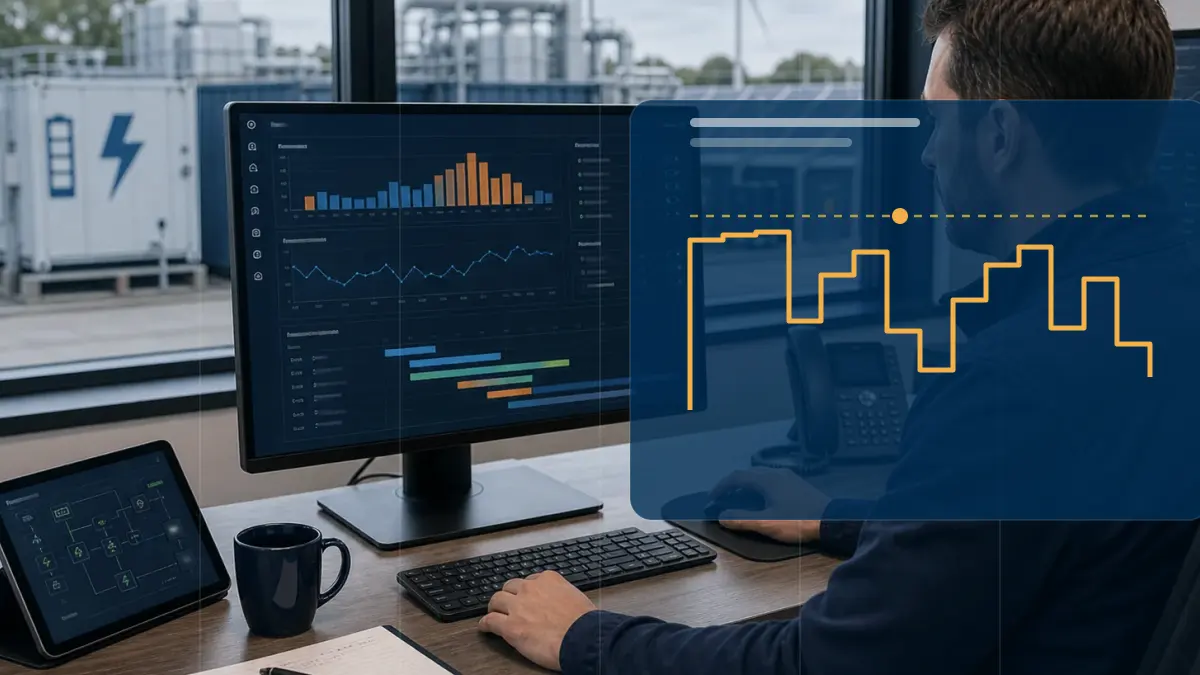
ICE ENDEX explained: scattered information versus Energy Intelligence
Energy prices move every day. For a company that wants a fixed price for the coming year, or a supplier promising customers a fixed rate, that uncertainty is a problem. On a forward exchange you can lock in a price for a future period now. ICE ENDEX is the largest such exchange in continental Europe for gas and electricity. The prices formed there drive the tariffs you ultimately pay as an end user.
- ICE ENDEX is a forward exchange: you buy or sell energy for delivery in a future period, from a month to years ahead.
- The Dutch TTF gas contract is the main price reference for gas in continental Europe; TTF itself is the virtual trading point operated by Gasunie Transport Services.
- Companies and energy suppliers use ICE ENDEX to fix their purchase price and hedge the risk of price swings.
Insight
Traditional approach
Information is scattered across portals, documents, invoices or separate spreadsheets.
Modern approach
Data, context and interpretation are brought together into a clear decision picture.
Decision-making
Traditional approach
Choices are made based on averages, assumptions or occasional analyses.
Modern approach
Scenarios, KPIs and current measurement data make the trade-off more concrete and repeatable.
Follow-up
Traditional approach
Actions often stay non-committal or disappear into separate reports.
Modern approach
Follow-up actions, monitoring and reporting are linked to the same energy data.
What is ICE ENDEX?
ICE ENDEX is an energy exchange for forward trading in gas and electricity in North West Europe. Parties trade futures: standardised contracts for delivery of a fixed amount of energy in a future period, at a price agreed now. Contracts run from the next month up to many years ahead, and can also be traded by quarter, season or calendar year. The best known is the Dutch TTF gas contract. TTF stands for Title Transfer Facility, the virtual gas trading point operated by Gasunie Transport Services. The TTF price serves as the reference price for gas across continental Europe. Alongside gas, ICE ENDEX also trades electricity.
- Exchange for forward trading in gas and electricity, focused on North West Europe.
- Trading in futures: contracts for delivery in a future month, quarter or year.
- The TTF gas contract is the leading gas price reference for continental Europe.
- TTF is the virtual gas trading point operated by Gasunie Transport Services.
What is the difference with EPEX SPOT?
ICE ENDEX and EPEX SPOT complement each other but cover different time horizons. EPEX SPOT is the spot market: electricity is traded there for delivery in the very short term, such as the day-ahead market for the next day and the intraday market for the same day. ICE ENDEX is the forward market: there you lock in prices for longer periods well ahead. A supplier buys most of its volume in advance on the forward market and fine-tunes the final amounts on the spot market. The spot price moves by the hour and follows supply and demand of the moment; the forward price reflects the expectation for a whole period.
- EPEX SPOT is the short-term market: day-ahead and intraday, delivery today or tomorrow.
- ICE ENDEX is the forward market: delivery in a future month, quarter or year.
- The spot price moves by the hour; the forward price applies to a whole period.
- Suppliers use both markets side by side to cover their purchasing.
What does this mean for your business?
For most companies, ICE ENDEX is not something you trade on yourself, but it does determine your energy costs. Your supplier buys on the forward market and passes that price on in your contract. If you choose a fixed rate, the supplier hedges it with futures on ICE ENDEX. If you choose a dynamic or variable rate, your price follows the market more directly. If you want to lock in a long-term price yourself, you do so through your supplier or an intermediary; direct access to the exchange is reserved for registered trading parties. Important to know: a fixed price gives certainty, but you do not benefit if the market falls.
- Your supplier buys on the forward market and works that price into your rate.
- A fixed rate means your supplier hedges the price risk with futures.
- A dynamic or variable rate follows the market price more directly.
- Direct exchange trading is reserved for registered trading parties; consumers and businesses trade through a supplier or intermediary.
Curious what this looks like with your own data?
In a no-obligation call, a specialist looks at your meters, sites and energy questions with you. Response within one business day.
Search the knowledge base
Find the answer to your question.
Search using your own words. Abbreviations and spelling variants are recognised, so EMS also finds the articles on energy management systems.
Topic