
Market dynamics
Article 15 of 20 · Energy markets and market dynamicsETS EU emissions trading: a guide for businesses
Direct answer
The ETS, in full the European Emissions Trading System, is a cap-and-trade market in which companies need emission allowances for their CO2 emissions. The European Union sets a ceiling on total emissions and lowers that ceiling every year. The allowances are tradable, which gives CO2 a price and makes avoiding emissions worthwhile.
- Clear definition
- Data-driven assessment
- Risks and opportunities visible
- Practical next steps
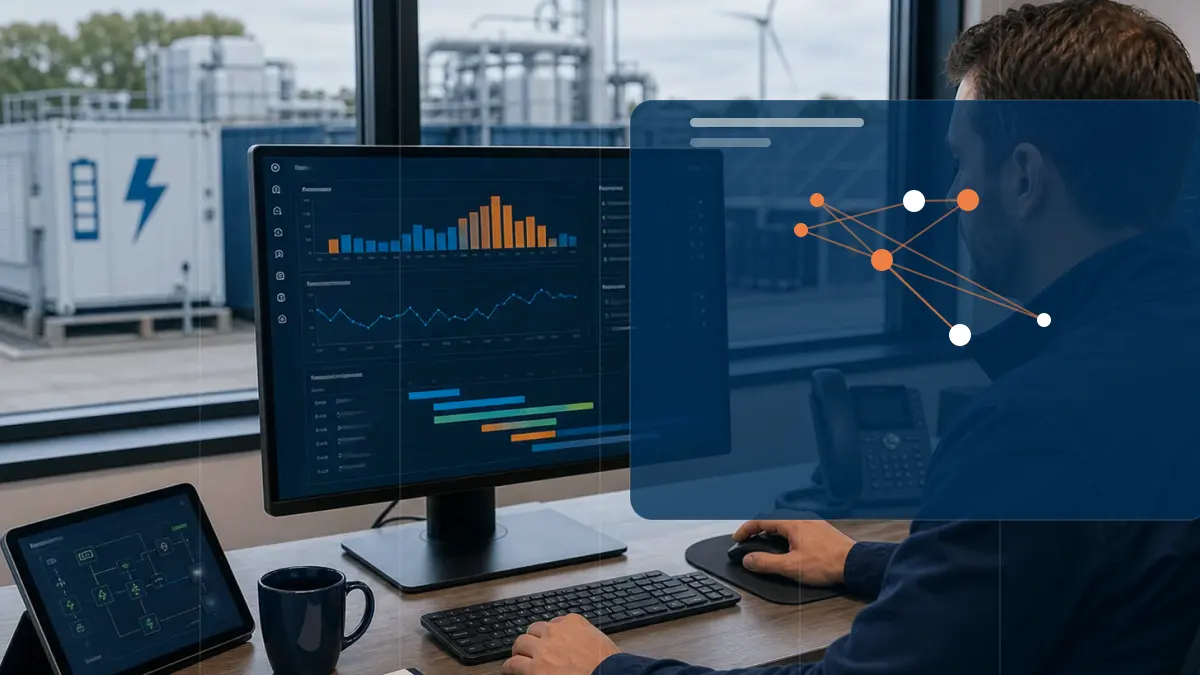
ETS EU emissions trading: scattered information versus Energy Intelligence
Europe wants to reduce greenhouse gas emissions and therefore puts a price on CO2. The emissions trading system is the main instrument for this. It matters to any organisation that uses or commissions a lot of energy: a factory that falls under the system itself, but also a business that buys electricity or heat with the CO2 price built in. Anyone trying to understand their energy costs will sooner or later encounter the ETS.
- The ETS works with a ceiling that falls every year: fewer and fewer allowances become available, making CO2 scarcer and more expensive.
- The current ETS covers heavy industry, electricity generation and aviation; a separate second system, the ETS2, is coming for fuels used in buildings and road transport.
- A company pays either directly for allowances or indirectly, as the CO2 price feeds through into the energy prices it pays.
Insight
Traditional approach
Information is scattered across portals, documents, invoices or separate spreadsheets.
Modern approach
Data, context and interpretation are brought together into a clear decision picture.
Decision-making
Traditional approach
Choices are made based on averages, assumptions or occasional analyses.
Modern approach
Scenarios, KPIs and current measurement data make the trade-off more concrete and repeatable.
Follow-up
Traditional approach
Actions often stay non-committal or disappear into separate reports.
Modern approach
Follow-up actions, monitoring and reporting are linked to the same energy data.
What is the ETS and how does it work?
The ETS is a cap-and-trade system. Cap stands for the ceiling: the European Union decides how much CO2 the participating sectors together may emit each year. Trade stands for the trading: within that ceiling companies buy and sell emission allowances, where one allowance represents roughly a tonne of CO2. The ceiling falls every year, so the total pool of allowances shrinks. Companies obtain allowances largely through auctions. At the end of a period every company must surrender enough allowances to cover its actual emissions. This creates a market price for CO2 and makes avoiding emissions financially attractive.
- One emission allowance equals emitting roughly one tonne of CO2.
- The European Union sets the ceiling and lowers it each year.
- Companies obtain allowances mainly through auctions and mutual trading.
- Every company afterwards surrenders allowances equal to its measured emissions.
Who falls under it?
The current ETS applies to the large emitters: energy-intensive industry such as steel, cement, chemicals and refining, electricity generation and aviation. Shipping has also been added to the system. Smaller businesses and households currently fall outside it. That is set to change with a second, separate system: the ETS2. It targets the CO2 from fuels for buildings and road transport, plus smaller industry not yet covered by the existing ETS. The ETS2 works upstream: not the driver or resident, but the fuel supplier has to arrange the allowances. Monitoring has already started, and the ETS2 is expected to apply from around 2027 and become fully operational in 2028.
- Currently under the ETS: heavy industry, electricity generation, aviation and shipping.
- The ETS2 is coming for fuels in buildings and road transport, plus smaller industry.
- Under the ETS2 the fuel suppliers surrender the allowances, not the end user.
- The ETS2 is expected to apply from around 2027 and become fully operational in 2028.
What does the ETS mean for your business?
If your business falls under the ETS itself, you measure and report your emissions and surrender enough allowances each year. This brings direct costs and requires administration and verification. In the Netherlands, the Dutch Emissions Authority supervises this. If you do not fall under it, you usually feel the ETS indirectly. The CO2 price is built into the price of electricity, because electricity producers buy allowances. With the upcoming ETS2, the price of gas and road transport fuel, for example, may move the same way. For both groups the same applies: using less energy and going greener reduces your exposure to the CO2 price.
- Companies under the ETS measure, report and surrender emission allowances each year.
- In the Netherlands the Dutch Emissions Authority supervises participants.
- Companies outside it feel the CO2 price indirectly through energy prices.
- Saving energy and going greener lowers exposure to the CO2 price.
Curious what this looks like with your own data?
In a no-obligation call, a specialist looks at your meters, sites and energy questions with you. Response within one business day.
Search the knowledge base
Find the answer to your question.
Search using your own words. Abbreviations and spelling variants are recognised, so EMS also finds the articles on energy management systems.
Topic