
Sector: Healthcare
Article 12 of 20 · Sector-specific softwareCutting energy costs across care sites without compromising on comfort
Direct answer
You cut the energy costs of care sites by finding waste that has nothing to do with residents' comfort: ventilation running at full load in empty rooms, heating without a night setback and installations that have drifted out of tune. COMCAM compares all your sites centrally and flags anomalies automatically, so a small facilities team keeps a grip on many buildings. Every euro that does not go on energy stays available for care.
- Saving without loss of comfort
- All care sites compared centrally
- Alerts for a small facilities team
- Substantiation for board and finance
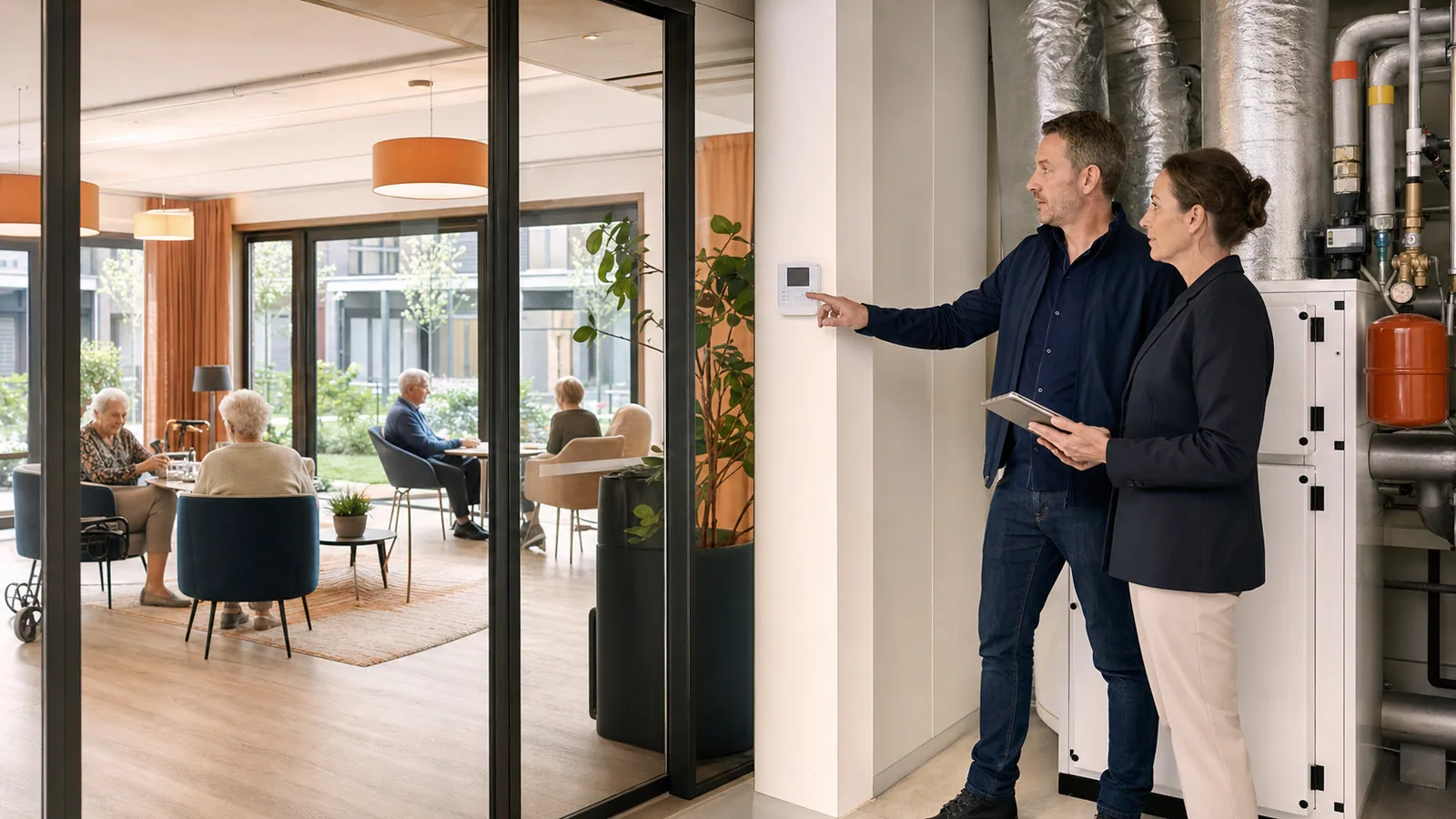
Cutting back on gut feeling versus cutting into waste
In care, every euro competes with care itself. When energy costs rise, everyone feels the reflex to cut back, but nobody wants a lounge to get colder or a bathroom less comfortable. The good news: that is not necessary. The biggest waste in care buildings sits in what nobody feels: the ventilation running at full load in an empty day-activity room, the heating that does not know the weekend schedule, the installation never properly recommissioned after a fault. COMCAM brings all sites together in one central view and flags these anomalies automatically. That way an already stretched facilities team keeps a grip on ten or thirty buildings at once, and the conversation with the board and finance shifts from cutting comfort to cutting waste.
- Find waste in equipment and settings, not in residents' comfort.
- Compare care sites fairly and see which buildings are out of step.
- Let alerts do the work: a small facilities team covers many sites.
- Substantiate the energy line in the budget with actual figures per site.
Starting point
Traditional approach
Savings quickly touch comfort and spark debate.
Modern approach
Waste in equipment is found and tackled first.
Overview
Traditional approach
Every site has its own bills and stories.
Modern approach
All buildings sit side by side in one comparable view.
Capacity
Traditional approach
Facilities chases reports and buildings.
Modern approach
Alerts point to where attention is genuinely needed.
Budget
Traditional approach
The energy line is an estimate with a margin.
Modern approach
Cost development per site substantiates the budget.
Saving without residents or care teams noticing anything
The safe route to lower energy costs runs through consumption that has no relation whatsoever to comfort or care continuity. Think of rooms fully ventilated and heated outside hours of use, a kitchen or laundry installation that also runs through the night, or a control setting never restored after maintenance. By laying consumption per site alongside hours of use and building function, this waste becomes visible without anyone having to enter a room. Comfort-critical functions stay explicitly outside the measures; it is precisely that distinction that makes saving in care responsible.
- Ventilation and heating in empty rooms and outside hours of use.
- Compare night and weekend consumption with the actual schedule.
- Recognise drifted installations by a shifted profile.
- Keep comfort-critical functions explicitly out of scope.
- See the effect of every adjustment safely reflected in the data.
A small team, many buildings: keeping the overview
Care organisations often manage dozens of sites with a facilities team that also carries faults, maintenance and refurbishments. Going through energy reports by hand understandably falls by the wayside. That is why COMCAM reverses the division of roles: the platform continuously monitors all meters and only reports what deviates. Sites are compared on a normalised basis, so a small nursing home is not unfairly placed next to a large residential care centre. The team does not have to search, only follow up, and sees for every alert exactly which building, which period and what magnitude is involved.
- Continuous monitoring of all sites and meters in the background.
- Only alerts that deserve follow-up, no noise.
- Normalised comparison per m2, function and use.
- Immediate context per alert: building, period and magnitude.
- No additional recording burden for care teams on site.
From insight to budget and board
In many care budgets, energy is a line item with a caveat. With consumption and costs per site, that line becomes verifiable: where do costs rise through tariffs and where through consumption, which buildings are improving and which need investment? That makes the conversation with the board, finance and where relevant the supervisory board more concrete, including for retrofit decisions. COMCAM is built modularly with a fixed price per meter per month, finalised once the scope is set. In a no-obligation call you discuss where the first waste may sit in your own data.
- Cost development per site, split between tariff and consumption.
- Substantiation for retrofit and maintenance decisions.
- Fixed price per meter per month, modularly extendable.
- Final price once the scope is set.
- No-obligation call: start at the sites with the biggest questions.
Curious what this looks like with your own data?
In a no-obligation call, a specialist looks at your meters, sites and energy questions with you. Response within one business day.
Search the knowledge base
Find the answer to your question.
Search using your own words. Abbreviations and spelling variants are recognised, so EMS also finds the articles on energy management systems.
Topic