
Sector: Real estate
Article 17 of 20 · Sector-specific softwareEnergy data in real estate management: from separate meters to a central view
Direct answer
Energy data in real estate management only becomes valuable when separate meters, buildings and tenants come together in a central, controllable view. COMCAM connects that data supplier-independently, so you can steer, compare and report on consumption and costs in a well-founded way.
- Meters and buildings connected centrally
- Traceable per building and tenant
- Supplier-independent data quality
- Ready for steering and reporting
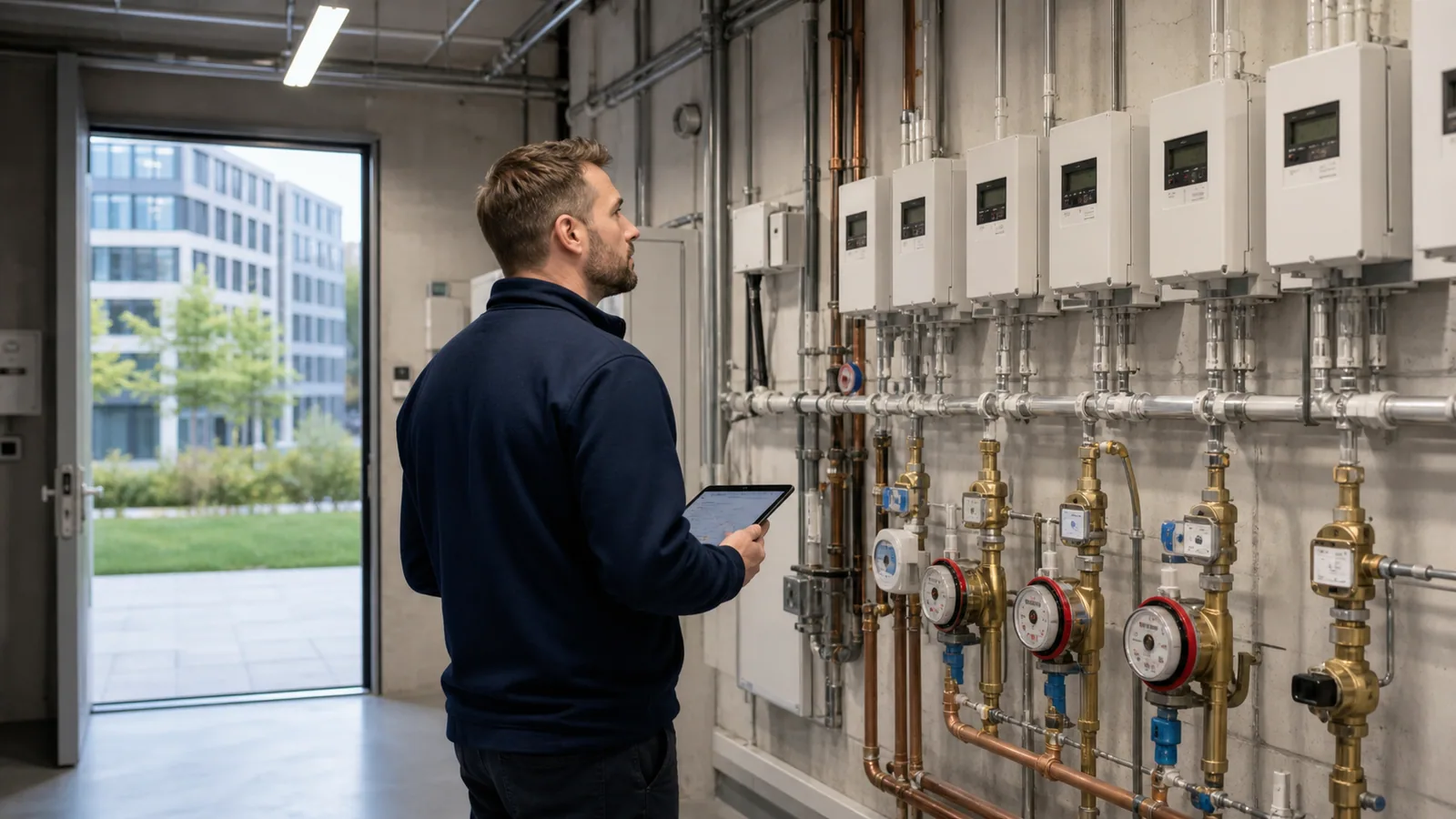
Fragmented meter data versus connected energy data
In real estate management, energy data is often fragmented across portals, invoices, tenants and suppliers. As a result, steering or reporting is time-consuming and error-prone. COMCAM brings that data together supplier-independently into a controllable view, so you compare buildings, see deviations and reuse data for cost allocation and reporting.
- Connect meter data of all buildings and tenants in a central overview.
- Make data traceable per building, meter and usage profile.
- Use reliable data for steering, cost allocation and ESG reporting.
Source
Traditional approach
Data scattered across portals, invoices and tenants.
Modern approach
A central overview across all buildings and meters.
Quality
Traditional approach
Gaps and differences remain unnoticed.
Modern approach
Alerts on data quality, missing meters and deviations.
Traceability
Traditional approach
Hard to trace back to building or tenant.
Modern approach
Consumption and costs traceable per building, meter and tenant.
Reuse
Traditional approach
Manual merging for every report.
Modern approach
The same data for steering, cost allocation and ESG reporting.
Which energy data do you connect?
The basis consists of quarter-hour values, meter and location data, floor area, building function and contract context. By structuring this per building and tenant, a reliable source emerges for both steering and reporting.
- Quarter-hour values for electricity and gas per meter.
- Meters, EANs, buildings, tenants and floor area.
- Costs, contracted capacity and tariff components.
- Data quality signals on gaps and deviations.
What does connected energy data deliver?
Once data is central and controllable, you can compare buildings fairly, signal deviations early and reuse data for on-charging to tenants and for ESG and CSRD reporting. Data recorded once thus serves multiple goals at the same time.
- Fair comparison of buildings, normalised per m2.
- Early signals on deviating consumption or silent waste.
- Well-founded on-charging per tenant.
- Traceable data for ESG and CSRD reporting.
Start modularly with COMCAM
You determine yourself how far the insight reaches and pay only for the modules you use. Start with consumption insight per building and expand to financial and capacity analysis. All prices are indicative and set after scope.
- Consumption Analysis at a fixed price per meter per month (base).
- Financial Analysis: fixed surcharge per meter per month.
- Capacity Analysis: fixed surcharge per meter per month.
- Asset Management and Congestion Management each at a fixed monthly price.
Curious what this looks like with your own data?
In a no-obligation call, a specialist looks at your meters, sites and energy questions with you. Response within one business day.
Search the knowledge base
Find the answer to your question.
Search using your own words. Abbreviations and spelling variants are recognised, so EMS also finds the articles on energy management systems.
Topic