
Dynamic prices
Article 7 of 14 · Portals, costs and contractsHow do I, as a company, benefit from dynamic energy prices?
Direct answer
Companies benefit from dynamic energy prices when they can shift consumption to cheap hours or avoid expensive peaks. This requires insight into profiles, flexibility, operational limits and contract risks.
- Shift consumption to cheap hours
- Monitor risk and volatility
- Use charging infrastructure and storage
- Substantiate the contract choice
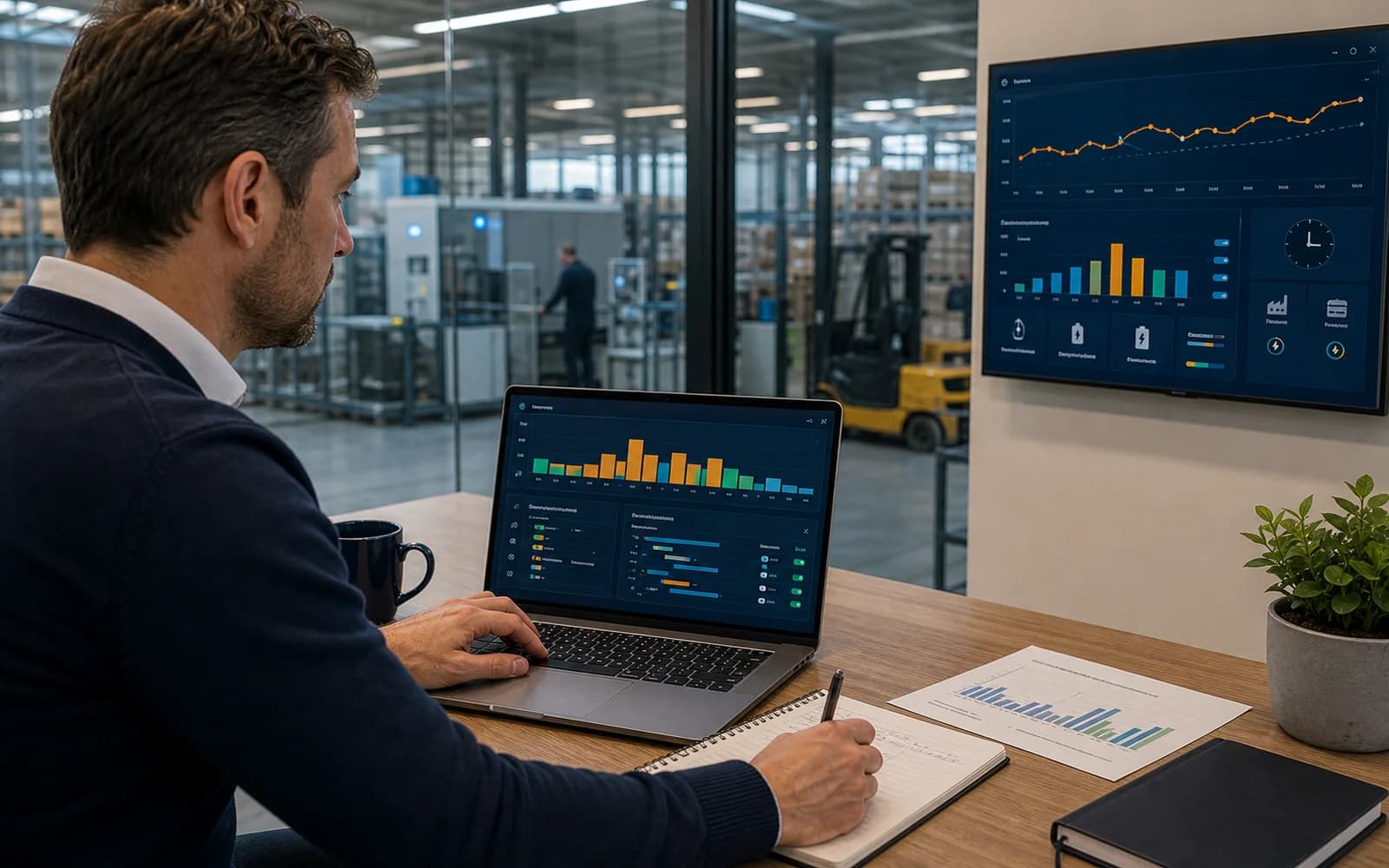
Dynamic contract versus data-driven price control
Dynamic prices offer opportunities, but only if a company can act on timing. Without flexibility, a dynamic contract is mainly a price risk; with good data it can become a control instrument.
- First look at which part of your consumption is flexible.
- Link dynamic prices to processes, charging infrastructure or storage.
- Watch the risk: low prices are attractive, but volatility can raise costs.
Start
Traditional approach
Switching to dynamic tariffs.
Modern approach
First analyse flexibility and profile.
Risk
Traditional approach
Accepting price volatility.
Modern approach
Using limits, alerts and scenarios.
Value
Traditional approach
Possible advantage at low prices.
Modern approach
Actively controlling on timing and cost impact.
Which processes are suitable?
Dynamic prices are especially interesting for processes that can be planned or buffered, such as charging, cooling, heating, storage or flexible production.
- Charging infrastructure and electric vehicles.
- Battery or heat buffer.
- Flexible production planning.
- Cooling or HVAC with limits.
Which data do you need?
You need insight into consumption per quarter-hour, operational limits, contract forms, price data and the cost impact of shifting.
- Analyse quarter-hourly profiles.
- Separate flexible and non-flexible consumption.
- Link price data to consumption.
- Calculate scenarios for shifting.
Curious what this looks like with your own data?
In a no-obligation call, a specialist looks at your meters, sites and energy questions with you. Response within one business day.
Search the knowledge base
Find the answer to your question.
Search using your own words. Abbreviations and spelling variants are recognised, so EMS also finds the articles on energy management systems.
Topic