
Invoice control
Article 14 of 14 · Portals, costs and contractsAutomatic energy invoice control: is your energy invoice really correct?
Direct answer
Automatic energy invoice control compares your energy invoices with the underlying meter data, the contract and the tariff components. This makes unexpected costs, duplicate items, wrong tariffs and deviations visible without anyone having to manually recalculate whole invoices.
- Check invoices against actual meter data
- Trace errors, duplicate costs and deviating tariffs
- Supplier-independent across all contracts
- Suitable for multi-site and multi-meter organisations
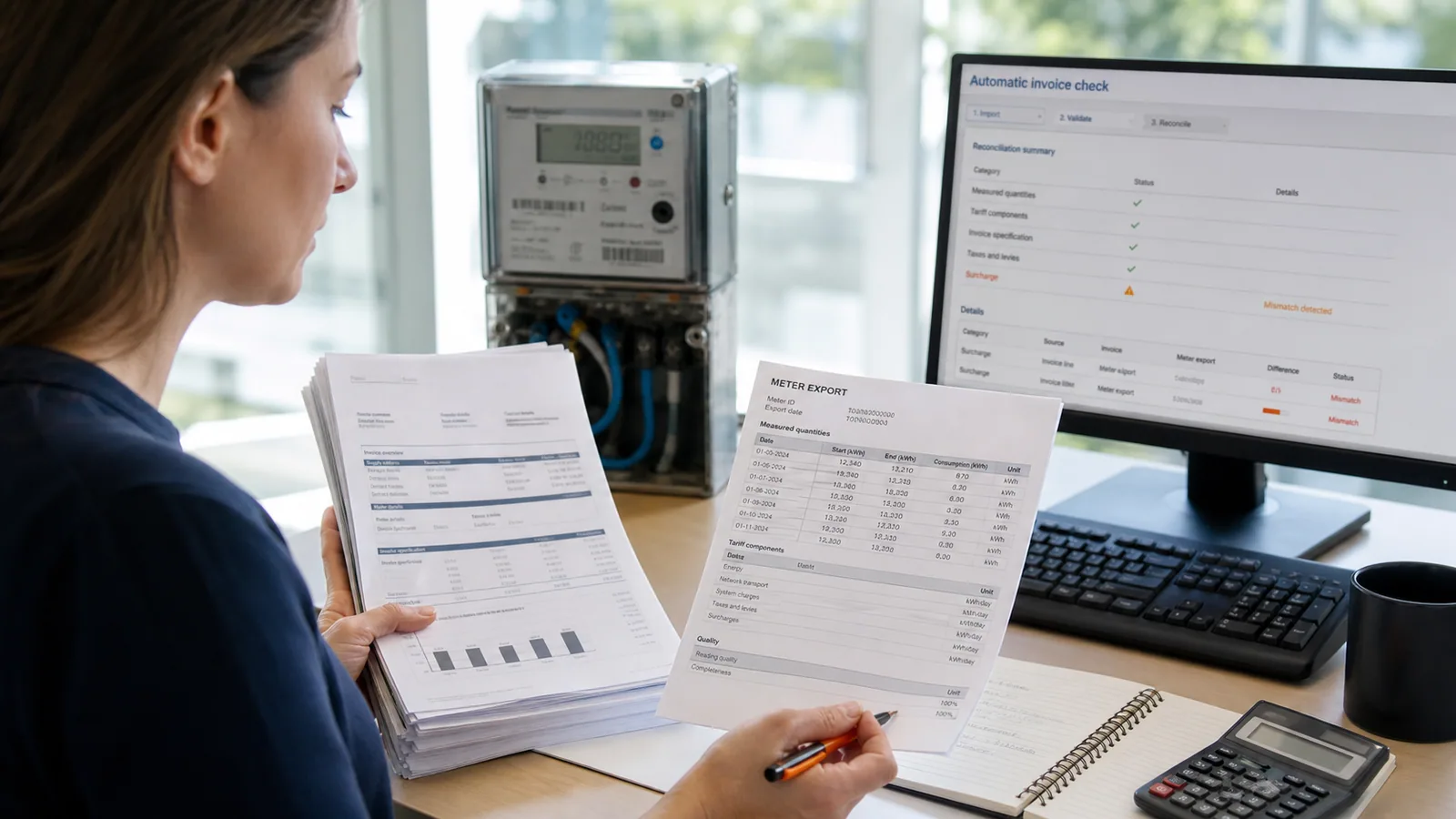
Manual review versus automatic invoice control
Energy invoices are complex: supply tariffs, grid tariffs, contracted capacity, taxes and settlements run together. As a result, errors often go unnoticed. Automatic invoice control sets each invoice next to the actual meter data and your contract agreements, so deviations stand out immediately. That is relevant for finance, procurement, facility and management who want certainty that paid costs are correct.
- Invoices are set against quarter-hour values, contracted capacity and agreed tariffs.
- Deviations, duplicate costs and wrong tariff components surface automatically.
- Especially valuable for organisations with multiple meters, sites or suppliers.
Method
Traditional approach
Sample or invoice placed next to the contract manually.
Modern approach
Set every invoice structurally against meter data and contract.
Coverage
Traditional approach
Often only large or conspicuous items.
Modern approach
All items, tariffs and settlements per meter and site.
Detection
Traditional approach
Errors only stand out late or by chance.
Modern approach
Deviations and duplicate costs are flagged immediately.
Substantiation
Traditional approach
Hard to prove to the supplier.
Modern approach
Deviation substantiated with meter data and contract context.
Why energy invoices often contain errors
An energy invoice consists of many components that can each deviate: estimated readings, wrong contracted capacity, faulty tariffs or double-invoiced periods. With multiple meters and sites that risk multiplies, while manual checking does not keep up.
- Estimated instead of actual meter readings.
- Wrong or outdated contracted capacity charged.
- Incorrect or double-charged tariff components.
- Settlements and corrections that are not correct.
How automatic invoice control works
The invoice is placed next to the underlying meter data and your contract agreements. Consumption, peak power, tariffs and settlements are compared, so deviations between what is measured and what is invoiced become visible. You keep the overview across all suppliers and sites in one place.
- Compare invoiced consumption with quarter-hour values.
- Check contracted capacity against the actual peak load.
- Test tariff components against the contract concluded.
- Signal duplicate items and incorrect settlements.
What invoice control delivers
The value lies not only in recovered errors, but also in certainty and time savings. Finance and procurement know that paid costs are correct and can raise discrepancies with the supplier, backed by evidence, whoever that is.
- Recover unjustified or duplicate costs.
- Less time spent on manual recalculation.
- Discuss deviations with suppliers with substantiation.
- Grip on energy costs across all sites.
Curious what this looks like with your own data?
In a no-obligation call, a specialist looks at your meters, sites and energy questions with you. Response within one business day.
Search the knowledge base
Find the answer to your question.
Search using your own words. Abbreviations and spelling variants are recognised, so EMS also finds the articles on energy management systems.
Topic