
Energy data
Article 21 of 25 · Energy insight and dataMonitoring energy consumption for businesses: a guide for businesses
Direct answer
Monitoring energy consumption means structurally measuring and tracking how much electricity, gas and heat your business uses, so you see where and when that energy is spent. In the Netherlands you start with the data you already have: the main meter, the P1 port of the smart meter, submeters and your energy invoice. This gives you insight to find waste, save in a targeted way and support mandatory reporting.
- Clear definition
- Data-driven assessment
- Risks and opportunities visible
- Practical next steps
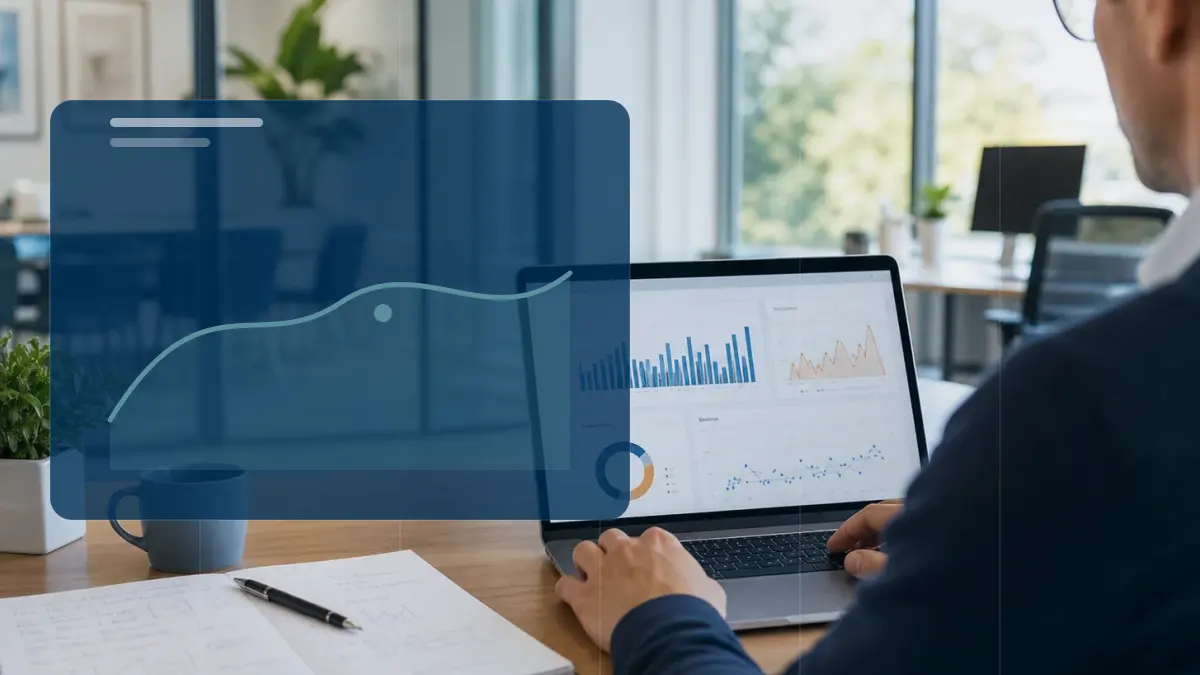
Monitoring energy consumption for businesses: scattered information versus Energy Intelligence
Many businesses only know their annual settlement and therefore do not know exactly where the energy goes. A cooling unit running all night or lighting in an empty warehouse never stands out that way. Monitoring makes that consumption visible over time. It matters to any entrepreneur, facility manager or finance lead who wants to cut costs, and certainly to companies that fall under the Dutch energy saving obligation and must be able to demonstrate their measures.
- You have four data sources at hand: the main meter, the P1 port of the smart meter, submeters per department or machine, and the annual settlement on your energy invoice.
- The practical route is: first measure, then build insight, then set targets, and finally follow up on whether it works.
- Monitoring supports the Dutch energy saving obligation and reporting obligation, which apply from 50,000 kWh of electricity or 25,000 cubic metres of gas per year per site.
Insight
Traditional approach
Information is scattered across portals, documents, invoices or separate spreadsheets.
Modern approach
Data, context and interpretation are brought together into a clear decision picture.
Decision-making
Traditional approach
Choices are made based on averages, assumptions or occasional analyses.
Modern approach
Scenarios, KPIs and current measurement data make the trade-off more concrete and repeatable.
Follow-up
Traditional approach
Actions often stay non-committal or disappear into separate reports.
Modern approach
Follow-up actions, monitoring and reporting are linked to the same energy data.
Which data do you need to start?
You do not have to invest in new equipment straight away. Start with what is already there. The main meter of your grid operator records the total consumption of the site. If you have a smart meter, you can connect your own reading device to the P1 port, which shows consumption almost in real time; grid operators do not charge for this. Submeters are added later behind the main meter, for example per department, per machine or per building section, so you can see which part causes which consumption. Your energy invoice and the annual settlement give the historical pattern and serve as a benchmark. Together these sources form the basis you build on.
- Main meter: the total consumption of the whole site.
- P1 port of the smart meter: almost real-time reading with your own device, free of charge.
- Submeters: consumption per department, machine or building section, behind the main meter.
- Energy invoice and annual settlement: the historical pattern as a benchmark.
- Note the unit for each source, kWh for electricity and cubic metres for gas.
Which steps do you take in sequence?
Monitoring is a cycle, not a one-off action. Step one is measuring: record what you consume and at which moments. Step two is insight: link consumption to activities, so you recognise peaks and unnecessary use outside working hours. Step three is setting targets: decide what you want to reduce and where the most room is, often in lighting, cooling, heating, ventilation and compressed air. Step four is follow-up: implement a measure and check in the figures whether consumption really drops. This approach aligns with the international standard ISO 50001 for energy management, which has the same measure-and-improve cycle at its core.
- Measure: structurally record consumption and moments.
- Insight: link consumption to activities and recognise peaks.
- Targets: choose where you want to reduce and by how much.
- Follow-up: implement a measure and verify it in the figures.
- Repeat the cycle; monitoring is continuous, not a one-off.
What does it deliver and what often goes wrong?
Insight into your consumption reveals waste you would otherwise pay for without noticing. You find equipment running needlessly, tune installations better and can save in a targeted way instead of guessing. Monitoring also supports your legal obligations. The Dutch energy saving obligation requires businesses that use a lot of energy to take measures that pay back within five years; the reporting obligation requires this to be reported once every four years to the environmental service. Without figures you cannot demonstrate that. The common mistake is stopping after reading the meter: gathering data without linking targets and follow-up to it delivers nothing.
- You see waste that otherwise stays invisible on the bill.
- Targeted saving on lighting, cooling, heating, ventilation and compressed air.
- Support for the energy saving obligation and the four-yearly reporting obligation.
- Common mistake: gathering data without targets and follow-up.
- Another mistake: tracking only the main meter, so you cannot see where consumption sits.
Curious what this looks like with your own data?
In a no-obligation call, a specialist looks at your meters, sites and energy questions with you. Response within one business day.
Search the knowledge base
Find the answer to your question.
Search using your own words. Abbreviations and spelling variants are recognised, so EMS also finds the articles on energy management systems.
Topic