
Capacity management
Article 2 of 4 · The analyses in depthWhat is capacity management? A grip on peaks, contracted capacity and grid capacity
Direct answer
Capacity management is steering on the power you demand at any given moment, rather than only on total consumption. It revolves around peaks: when do they occur, how do they relate to your contracted capacity and grid connection, and what can you shift? On a congested power grid, that increasingly determines whether your organisation can grow.
- Peaks determine cost and risk
- Finding room within the connection
- An answer to grid congestion
- Foundation for control and flexibility
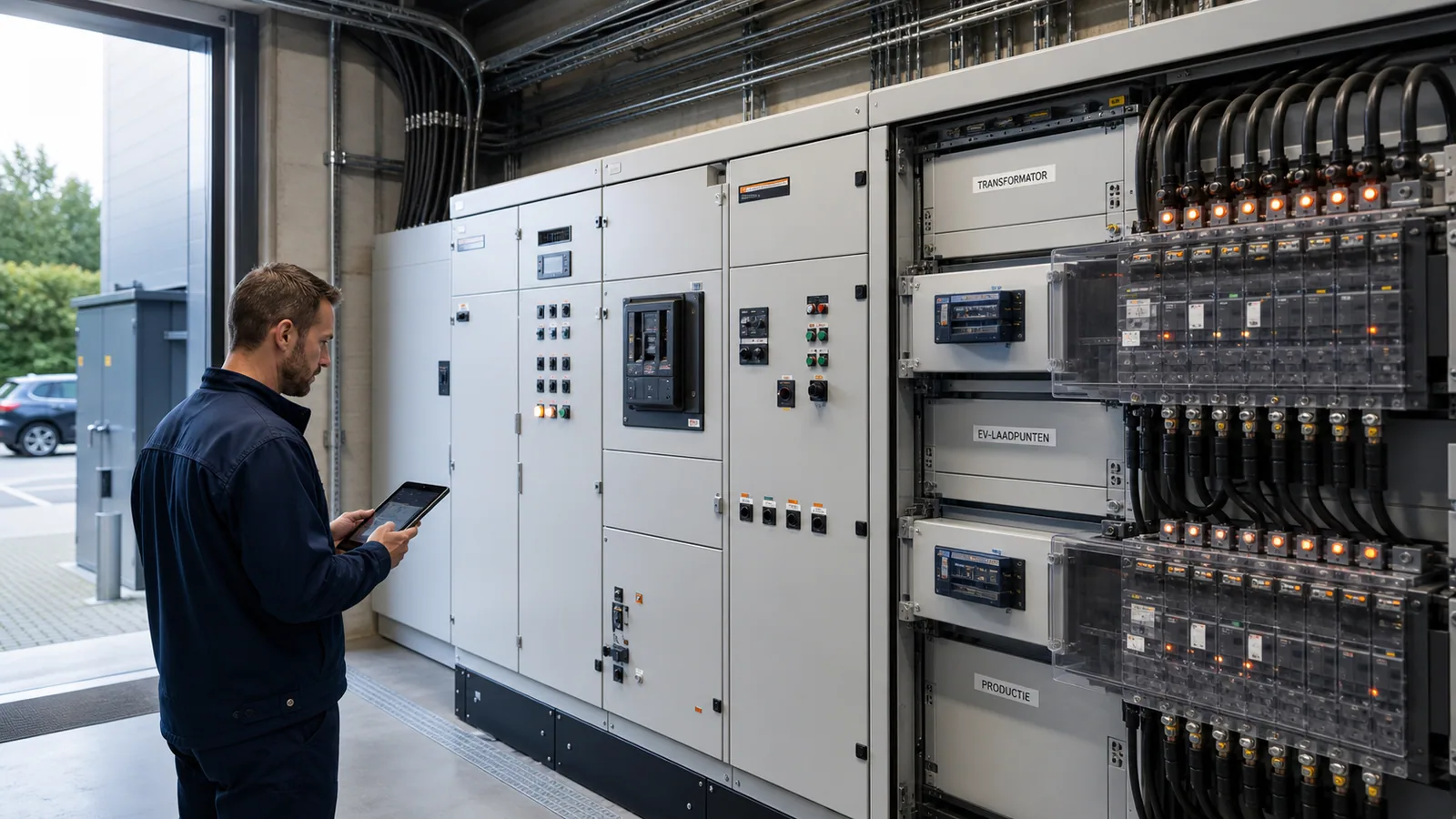
Capacity management versus upgrading the connection
For years, the grid connection was something no one thought about: there was always room, and whoever needed more simply requested more. That time is over. In many places in the Netherlands and Flanders the power grid is full and expansions go on a waiting list, while organisations are electrifying at the same time: heat pumps, charging points, electric processes. That shifts the core question from how much do I consume to how much do I demand at the same time. That is exactly what capacity management is about. It is the discipline that makes peaks visible, explains them and keeps them manageable, so that you can do more within your existing connection than you think. For some it is an insurance policy against surprises; for others it is the only way to keep growth plans on track. This page explains why capacity is the new bottleneck, which components interact within capacity management and how you can start today.
- Not total consumption but the highest peak determines your connection, contracted capacity and capacity risk.
- Capacity management makes peaks visible, explains them and looks for room within the existing connection.
- Because of grid congestion, extra capacity is unavailable in many places, or only after a long wait.
- The components: peak detection, utilisation of contracted capacity, simultaneity of loads and controllable flexibility.
Starting point
Traditional approach
Need more? Then request a heavier connection.
Modern approach
First know what you actually demand and what can be shifted.
Availability
Traditional approach
Upgrading is impossible in many places, or only after years of waiting.
Modern approach
Room within the existing connection is often already there.
Insight
Traditional approach
A peak only stands out after an exceedance or a higher invoice.
Modern approach
Every peak is visible, explainable and predictable.
Next step
Traditional approach
Waiting for the grid operator.
Modern approach
Planning processes smartly and making assets controllable.
Why capacity is the new bottleneck
For anyone who has never dealt with it, it takes some getting used to: it is no longer just about kilowatt-hours, but about kilowatts. Total consumption says how much energy passed through in a year; the peak says how much you demanded at the same time during the busiest quarter-hour. That peak determines which contracted capacity you need, whether your connection is sufficient and whether your plans fit onto a power grid that is full in many places. An organisation that electrifies without looking at peaks usually discovers the bottleneck at the worst possible moment: when applying for charging points, at the quote for a heat pump or in a letter from the grid operator. Capacity management reverses that order. First understand what you demand and when, then decide whether more is really needed. Surprisingly often, the peak turns out to come from a handful of moments per week that could easily be arranged differently.
- Consumption (kWh) and power (kW) are different questions; the peak determines the bottleneck.
- Grid congestion makes expansion slow or impossible in many places.
- Electrification (charging infrastructure, heat pumps, electric processes) mainly increases simultaneous demand.
- Whoever knows their peaks decides on facts instead of on the waiting list.
The components of capacity management
Capacity management starts with peak detection at quarter-hourly level: when do the highest loads occur, how often, and which processes coincide at that moment? The second building block is the utilisation of contracted capacity: how close do the peaks come to what was agreed, and how much headroom or surplus is there? The third is simultaneity: peaks rarely arise from a single consumer, but because several processes happen to coincide, from the kitchen starting up to vehicles charging at the same time. The fourth building block is room for action: what can be shifted, phased or capped, and which assets can be made controllable? Within COMCAM, this grows from Capacity Analysis as an insight module into Asset Management and Congestion Management, in which controllable assets respond automatically to prices and congestion signals.
- Peak detection: the highest quarter-hours, their timing and their cause.
- Utilisation of contracted capacity: how much headroom or surplus sits in the agreement?
- Simultaneity: which processes coincide, and do they really have to?
- Room for action: shift, phase, cap and ultimately control automatically.
For the expert: from load duration curve to congestion signal
Those who want to go deeper lay the quarter-hourly data along a load duration curve: sort all quarter-hours from high to low and see at a glance how many hours per year demand really comes close to the maximum. Often that is a surprisingly thin sliver, and precisely that sliver determines the connection rating. It gets interesting when you ask which combination of consumers causes that sliver: simultaneity analysis per meter and per process points out the candidates that can be shifted or capped. On top of that come the contractual frameworks, such as the contracted transport capacity for large consumers, and the new instruments from congestion management, in which flexibility is temporarily restricted or deployed in coordination with the grid operator, potentially with compensation in return. Capacity thus shifts from a fixed ceiling to a playable bandwidth.
- Load duration curve: how many hours per year does demand really push against the maximum?
- Simultaneity analysis points out the processes that jointly cause the peak.
- Contracted transport capacity and connection rating form the contractual framework.
- Congestion management turns flexibility into an agreement with the grid operator, with compensation as a possibility.
How to start: first see, then steer
The temptation with capacity issues is to jump straight to solutions: a battery, a heavier connection, a smart charging system. But every good decision starts with the same picture: your own peaks, their timing and their cause. That picture is available quickly; it is already in the quarter-hourly data from your meters. Then follows the logical staircase: first plan and shift what can be done without investment, then cap where that is responsible, and only then invest in control or storage, substantiated with your own data. That way you avoid spending money on a solution for a peak that would have disappeared with a different production schedule. Capacity management is therefore not a one-off project, but a standing part of how you deal with energy, certainly as long as the grid remains congested.
- Start with the picture: peaks, timing and cause from your own quarter-hourly data.
- Follow the staircase: first shift, then cap, only then invest.
- Always substantiate investments in storage or control with your own data.
- Treat capacity as an ongoing routine, not as a one-off project.
Curious what this looks like with your own data?
In a no-obligation call, a specialist looks at your meters, sites and energy questions with you. Response within one business day.
Search the knowledge base
Find the answer to your question.
Search using your own words. Abbreviations and spelling variants are recognised, so EMS also finds the articles on energy management systems.
Topic