
ESG for SMEs: a guide for businesses
Direct answer
ESG for SMEs means demonstrably managing the environment (Environment), social aspects (Social) and good governance (Governance). Most Dutch SMEs do not fall under the CSRD reporting obligation themselves, but they are affected indirectly through the value chain. Large clients, banks and insurers increasingly request sustainability data from their suppliers.
- Clear definition
- Data-driven assessment
- Risks and opportunities visible
- Practical next steps
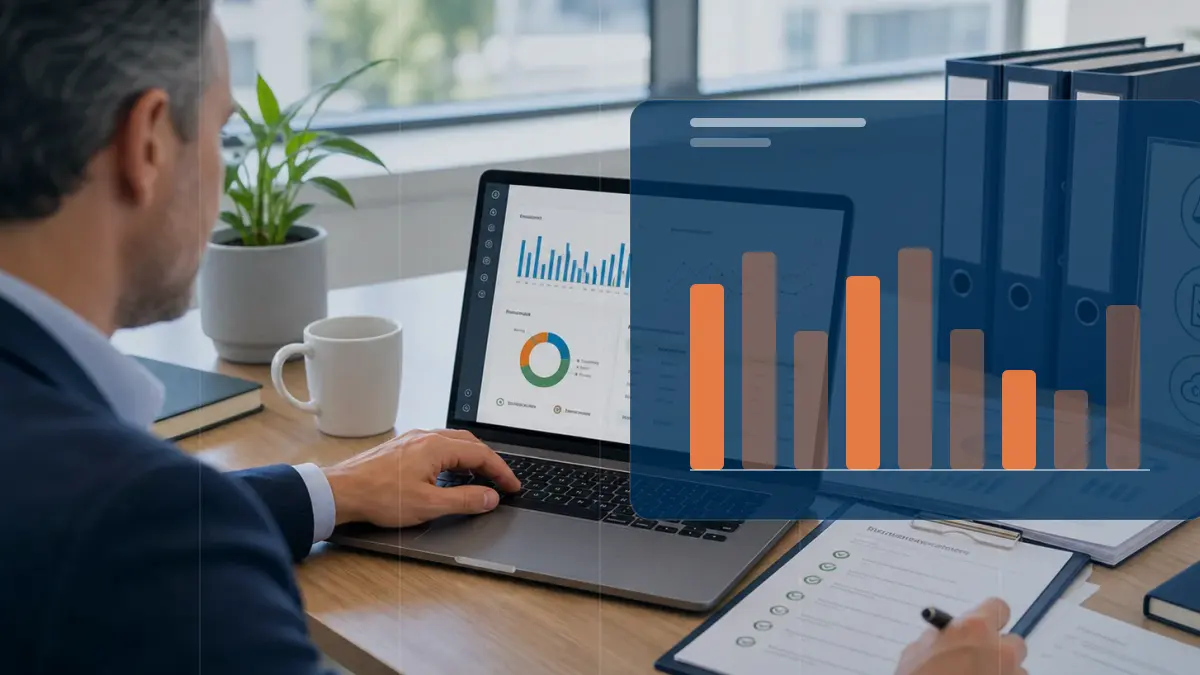
ESG for SMEs: scattered information versus Energy Intelligence
More and more Dutch SME owners hear the question: what does your company do about sustainability? That question rarely comes from the legislator, but from a large customer who has to report, or from a bank during a financing request. A supplier that wants to keep the factory door open, or a construction firm bidding on a tender, is the first to face it. So ESG matters even when you are not formally obliged.
- If you stay under the turnover and staff thresholds, you do not have to report under the CSRD yourself, but you often supply data to large clients who do.
- The VSME is a voluntary European standard from EFRAG, made specifically for SMEs: lighter than the CSRD and intended as a proportionate tool.
- Start small: first map your energy use and CO2 emissions, take the easy savings, and report step by step.
Insight
Traditional approach
Information is scattered across portals, documents, invoices or separate spreadsheets.
Modern approach
Data, context and interpretation are brought together into a clear decision picture.
Decision-making
Traditional approach
Choices are made based on averages, assumptions or occasional analyses.
Modern approach
Scenarios, KPIs and current measurement data make the trade-off more concrete and repeatable.
Follow-up
Traditional approach
Actions often stay non-committal or disappear into separate reports.
Modern approach
Follow-up actions, monitoring and reporting are linked to the same energy data.
Why does ESG affect SMEs too?
Large companies fall under the CSRD, the European directive for sustainability reporting. Companies with fewer than one thousand employees and turnover below 450 million euros fall outside it themselves. Even so, ESG enters through the value chain. Companies under the CSRD must also report on their chain partners and therefore request sustainability data from suppliers. The same goes for banks and insurers, who weigh sustainability in financing and policies. In this way ESG becomes a condition for continuing to do business for Dutch SMEs, even without a reporting obligation of their own. The letters stand for Environment, Social and Governance.
- The CSRD requires large companies to report on their entire value chain, including suppliers.
- If you stay under the thresholds, you are not obliged to report yourself, but the questions are passed on to you.
- Banks and insurers request sustainability data during financing and insurance.
- Without data you miss out on work from clients who fall under the CSRD themselves.
What can you do in practice?
Start with the basics: map your energy use and CO2 emissions. Your energy invoices and meter readings are the starting point. Then take the easy improvements, such as LED lighting, better tuning of installations and smarter energy purchasing. For the reporting itself, EFRAG offers the VSME, a voluntary European standard made specifically for SMEs. It consists of a basic module and a comprehensive module. The basic module asks, among other things, about your energy use and greenhouse gas emissions. You decide how far you go, in line with your size and the questions you receive.
- First map your energy use and CO2 emissions using invoices and meter readings.
- Take the easy savings: lighting, tuning and smarter energy purchasing.
- Use the voluntary VSME standard as a proportionate framework, with a basic module and a comprehensive module.
- Store your data in a structured way, so you can answer a client request in one go.
What does it deliver and how do you avoid over-reporting?
Insight into your ESG performance delivers value right away. You keep access to work from large clients, you stand stronger with banks and insurers, and mapping energy often leads to lower costs. You make your company more future-proof. Watch out for over-reporting: you do not have to do everything at once. The VSME is meant precisely to bundle the many separate data requests into a proportionate whole that fits an SME. Work step by step and do not supply more than is asked. A thin but correct report is worth more than a thick one you cannot substantiate. Choose a level that fits your size and your client questions.
- Keep access to work and financing by having sustainability data ready.
- Mapping energy often leads to concrete cost savings.
- The VSME bundles separate data requests into a proportionate whole; do not supply more than asked.
- Build up step by step and choose a level that fits your company.
Curious what this looks like with your own data?
In a no-obligation call, a specialist looks at your meters, sites and energy questions with you. Response within one business day.
Search the knowledge base
Find the answer to your question.
Search using your own words. Abbreviations and spelling variants are recognised, so EMS also finds the articles on energy management systems.
Topic