
Energy management maturity model: a guide for businesses
Direct answer
An energy management maturity model is a ladder of successive levels that shows how far energy management has developed in your organisation. It runs from ad hoc and reactive to structured and continually improved. You use it to place your current situation honestly and choose a growth path, not as a goal in itself.
- Clear definition
- Data-driven assessment
- Risks and opportunities visible
- Practical next steps
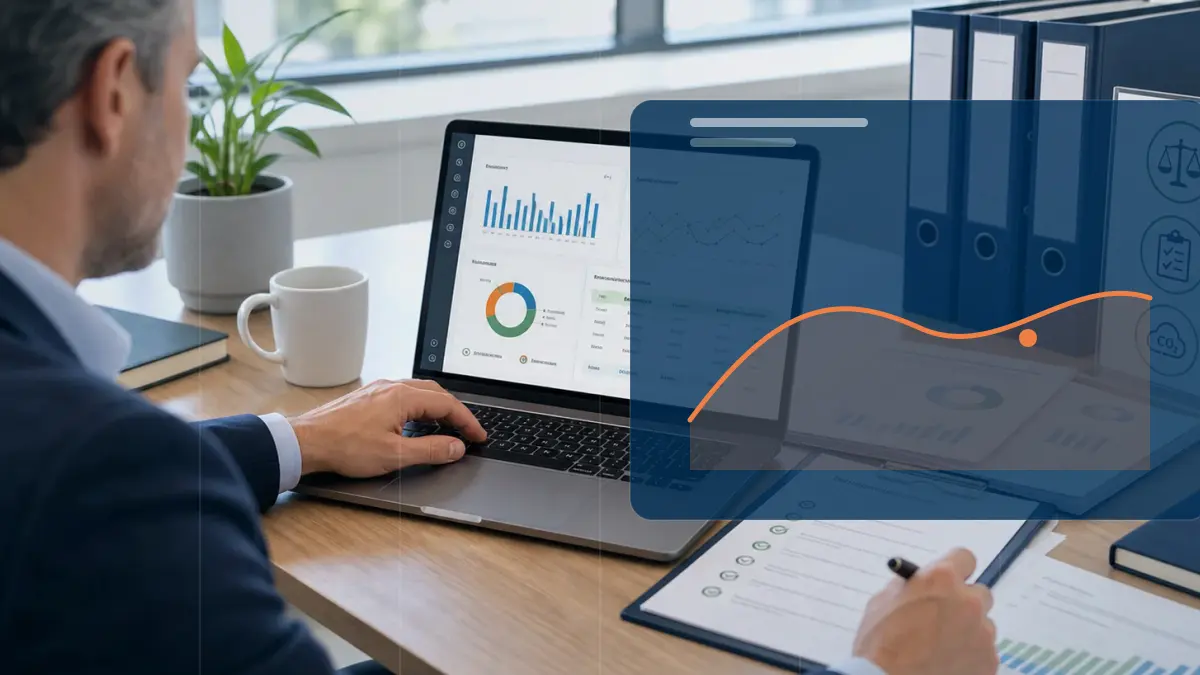
Energy management maturity model: scattered information versus Energy Intelligence
Many organisations save energy in isolated projects: insulation once, LED lighting once, reading a meter once. There is no coherence, and after a busy quarter attention fades. A maturity model makes visible where you stand and what a logical next step is. It matters to any organisation that wants to take energy seriously, from a facilities team just starting out to a company working towards a certified system.
- The model describes levels that rise from loose, reactive actions to fixed, measured and continually improved energy management.
- You establish your starting level with a baseline assessment and then set one or two levels higher as a realistic target.
- It is a tool for choosing priorities; the value lies in the improvements themselves, not in reaching a label.
Insight
Traditional approach
Information is scattered across portals, documents, invoices or separate spreadsheets.
Modern approach
Data, context and interpretation are brought together into a clear decision picture.
Decision-making
Traditional approach
Choices are made based on averages, assumptions or occasional analyses.
Modern approach
Scenarios, KPIs and current measurement data make the trade-off more concrete and repeatable.
Follow-up
Traditional approach
Actions often stay non-committal or disappear into separate reports.
Modern approach
Follow-up actions, monitoring and reporting are linked to the same energy data.
What is an energy management maturity model?
A maturity model is a yardstick in the form of successive levels. Each level describes how an organisation deals with energy: who is responsible, whether measurement happens, and whether improving is a habit or a coincidence. Such models come from the broader management literature, where they rank processes from initial and chaotic to optimised. Applied to energy, the levels usually run from reactive and unstructured to a fixed system that continually improves itself. That top level aligns with the idea behind the international standard ISO 50001, which sets up energy management as a cycle of plan, do, check and act. The model itself does not prescribe technology; it describes the maturity of behaviour and organisation.
- Each level describes behaviour and organisation, not which technology you buy.
- The levels rise from reactive and loose to structured and continually improved.
- The top level resembles a working management system in the spirit of ISO 50001.
- Exact level names differ per model; treat them as a common grouping, not a fixed law.
What do the levels usually look like?
Most models have four or five levels with a similar thread. At the bottom, energy is on no one's agenda: actions are ad hoc and follow a complaint or a high bill. A step up there is awareness, but management depends on individuals and on isolated measurements. Above that, energy management becomes a documented process with clear tasks, targets and periodic reporting. At the highest level, improving is a habit: you steer on performance indicators, compare against a baseline and keep adjusting the approach. The exact labels, such as reactive, aware, structured or optimised, differ per model. Translate them into recognisable behaviour in your own organisation rather than staring at the label.
- Bottom level: actions are loose and reactive, energy is not on the agenda.
- Middle levels: awareness grows, but management depends on individuals and isolated measurements.
- Higher level: a fixed process with tasks, targets and periodic reporting.
- Highest level: continual improvement with performance indicators and a baseline.
- Names differ per model; look at the behaviour, not the label.
What do you use it for, and what are the limits?
An organisation first uses the model for an honest baseline assessment: where do we stand now, across departments. That outcome makes conversations concrete, including with senior management, because a level is easier to grasp than a stack of loose figures. It then serves as a growth path: you choose a realistic next level and derive priorities from it, for example setting up measurement before steering on indicators. The limit matters. The model is a tool, not a goal. Reaching a higher level without energy use or decision-making genuinely improving is a false gain. Use the model to set direction, and let the real savings and better decisions be the proof.
- Baseline: honestly establish where you stand now, across departments.
- Conversation: a level is easier for management to grasp than loose figures.
- Growth path: choose a realistic next level and derive priorities from it.
- Limit: the model is a tool; the real value is lower use and better decisions.
Curious what this looks like with your own data?
In a no-obligation call, a specialist looks at your meters, sites and energy questions with you. Response within one business day.
Search the knowledge base
Find the answer to your question.
Search using your own words. Abbreviations and spelling variants are recognised, so EMS also finds the articles on energy management systems.
Topic