
Energy coordinator role and responsibilities: a guide for businesses
Direct answer
An energy coordinator is the designated person within an organisation who monitors energy consumption, spots saving opportunities and coordinates energy measures and reporting. The energy coordinator, also called energy manager, is the bridge between the technical team, facilities and management. In an energy management system under ISO 50001 this is the responsible person that top management appoints to keep the system running.
- Clear definition
- Data-driven assessment
- Risks and opportunities visible
- Practical next steps
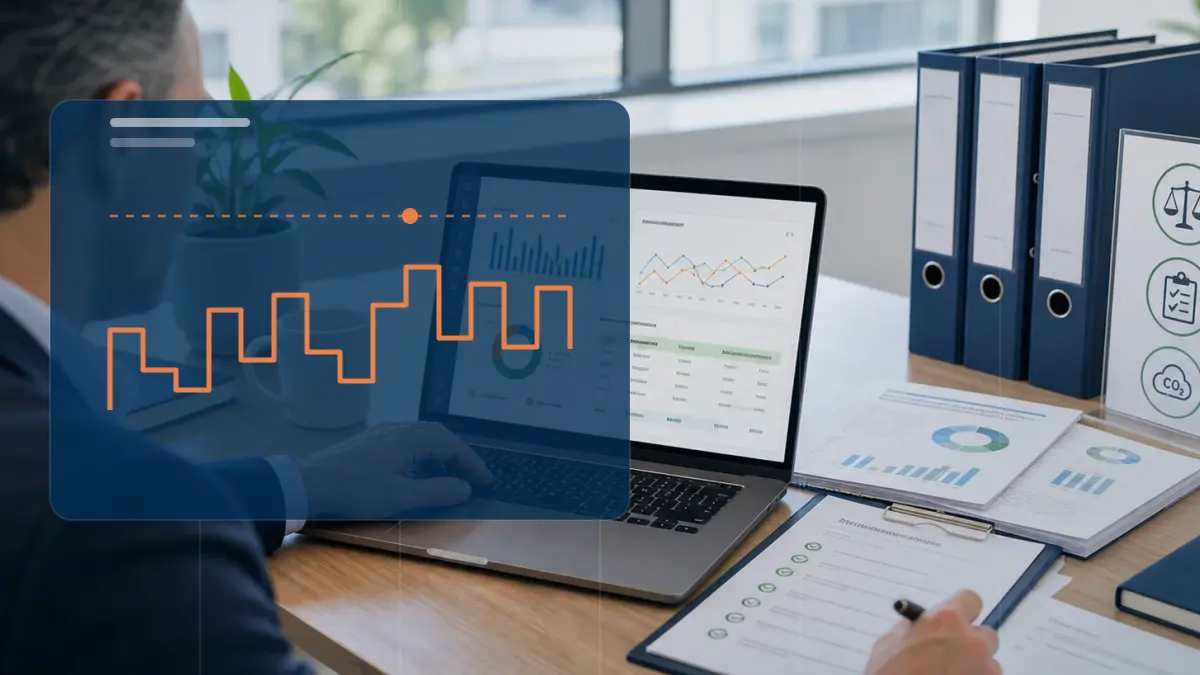
Energy coordinator role and responsibilities: scattered information versus Energy Intelligence
Many organisations want to save energy, but the knowledge and the data are scattered across the technical, facilities, procurement and finance teams. Without someone who oversees the whole, measures stay loose. Take a company that has smart meters but where nobody reviews the figures in a structured way. The energy coordinator fills that gap. The role is mainly relevant for businesses with a Dutch energy saving obligation, a reporting duty or an energy management system, and for organisations that want to genuinely embed sustainability.
- The energy coordinator monitors consumption data, signals saving opportunities and drives measures and reporting, without taking over the authority of management.
- In an energy management system under ISO 50001 management appoints this role; overall responsibility for the system stays with management itself.
- The role only works with a clear mandate and enough time; without both, it stays limited to isolated actions and the result fades.
Insight
Traditional approach
Information is scattered across portals, documents, invoices or separate spreadsheets.
Modern approach
Data, context and interpretation are brought together into a clear decision picture.
Decision-making
Traditional approach
Choices are made based on averages, assumptions or occasional analyses.
Modern approach
Scenarios, KPIs and current measurement data make the trade-off more concrete and repeatable.
Follow-up
Traditional approach
Actions often stay non-committal or disappear into separate reports.
Modern approach
Follow-up actions, monitoring and reporting are linked to the same energy data.
What does an energy coordinator do?
An energy coordinator turns energy into a managed process instead of a series of loose projects. The role starts with insight: collecting, checking and tracking consumption data, so that deviations and trends become visible. On that basis the coordinator spots saving opportunities and translates them into concrete measures. Next, the coordinator directs the execution and the reporting: who does what, when, and what does it deliver. The connecting role is just as important. The energy coordinator is the link between the technical team that manages the installations, the facilities organisation that keeps the building running, and management that sets budget and priority. This way energy policy lands in practice instead of in a drawer.
- Monitor energy consumption and data and signal deviations.
- Identify saving opportunities and translate them into concrete measures.
- Coordinate the execution of measures and internal and legal reporting.
- Form the bridge between the technical team, facilities, procurement and management.
Where does the role sit in an energy management system?
Energy management is the structured running of the plan-do-check-act cycle to increase energy efficiency: set policy, plan actions, carry out measures, check results and adjust. The world standard for this is ISO 50001. In that standard, overall responsibility for the energy management system lies with top management. Management appoints a responsible person, often an energy coordinator or energy manager, and usually an energy team. That responsible person keeps the system running: they safeguard the targets, provide the data on which management decides, and connect the departments involved. The role does not necessarily require a certificate, but it does require a clear position: appointed, known within the organisation and backed by management.
- Energy management follows the plan-do-check-act cycle for continual improvement.
- ISO 50001 is the international standard for an energy management system.
- Overall responsibility lies with management, which appoints the coordinator.
- The coordinator often works with an energy team from several departments.
Which skills and limits come with it?
The role combines technology, figures and collaboration. The energy coordinator reads consumption data, recognises what a deviation means and can translate it into clear language for management. Knowledge of the installations helps to assess opportunities; knowledge of the rules helps to meet reporting duties on time. Just as important are the soft skills: persuading, getting departments on board and making priorities discussable. The role also has clear limits. An energy coordinator without a mandate can advise, but cannot enforce anything. And without dedicated time the task disappears behind daily work. Anyone who takes the role seriously therefore arranges a clear assignment, a fixed time allocation and backing from management.
- Analytical: reading consumption data, interpreting deviations and translating them.
- Technical and legal: knowing the installations and reporting duties.
- Communicative: getting departments on board and advising management.
- Preconditions: a clear mandate and enough dedicated time.
Curious what this looks like with your own data?
In a no-obligation call, a specialist looks at your meters, sites and energy questions with you. Response within one business day.
Search the knowledge base
Find the answer to your question.
Search using your own words. Abbreviations and spelling variants are recognised, so EMS also finds the articles on energy management systems.
Topic