
Platform landscape
Article 1 of 13 · Choosing platforms and providersWhich energy management platforms exist in the Netherlands and Flanders?
Direct answer
In the Netherlands and Flanders, energy management platforms exist in various categories: supplier portals, metering company portals, EMS dashboards, portfolio platforms, submetering solutions and advice-driven energy platforms. The right choice depends on your data, sites, contracts and need for follow-up.
- Compare platforms by purpose and scope
- Not every dashboard is a full EMS
- Independence prevents lock-in
- Multi-site calls for portfolio thinking
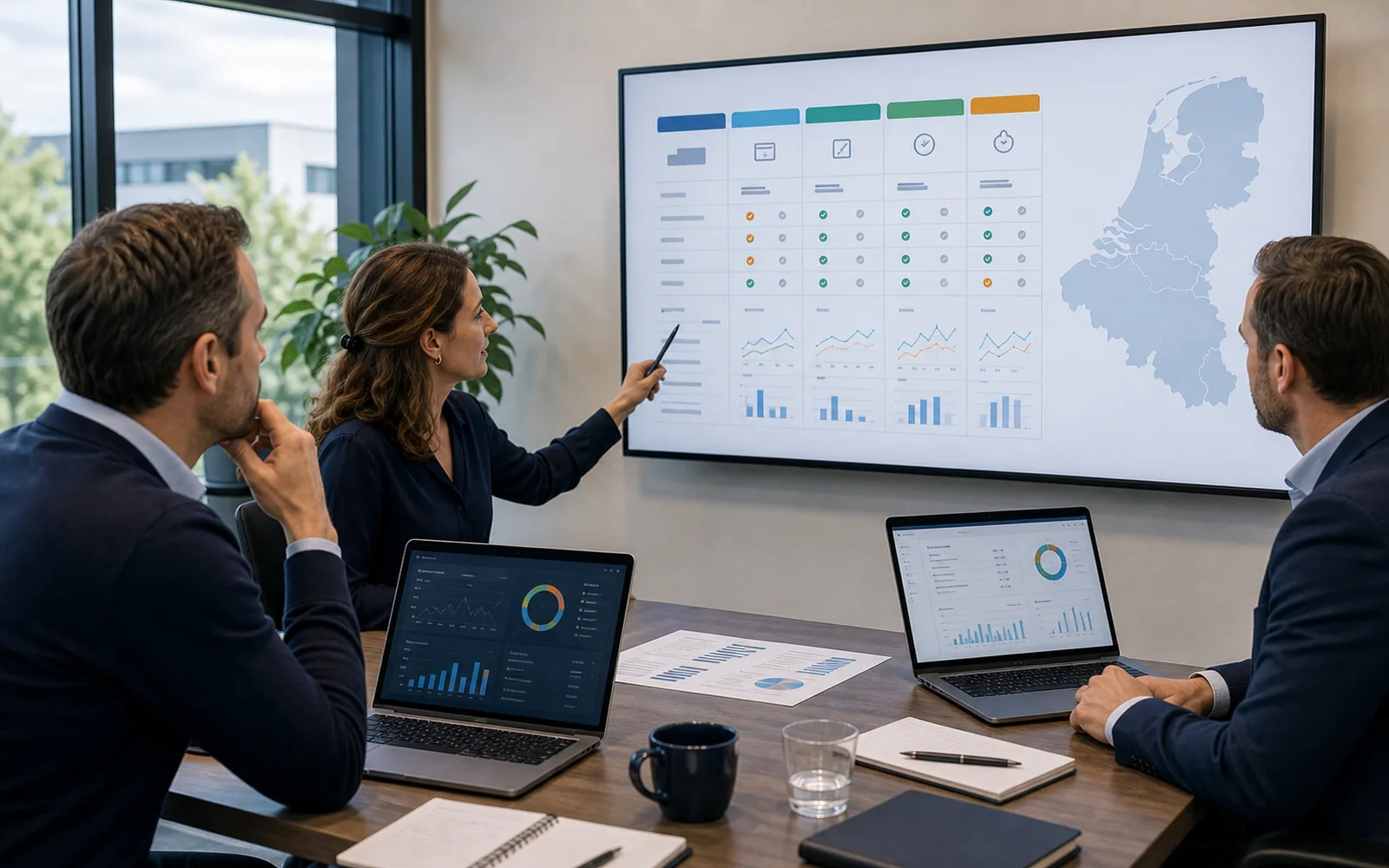
Basic portal versus full energy management platform
The market for energy management is broad. Some solutions focus on basic insight, others on hardware measurements, portfolio overview, grid capacity or energy advice. For businesses, the key is whether the platform fits their own energy demand and not just shows nice charts.
- Compare platforms first by purpose: insight, reporting, procurement, control or monitoring.
- Watch out for independence, data sources, multi-site capabilities and support.
- A platform is only valuable when insights lead to actions or better decisions.
Purpose
Traditional approach
Insight into meter readings or consumption.
Modern approach
Analysis, prioritisation, reporting and follow-up.
Scope
Traditional approach
One source, supplier or metering company.
Modern approach
Multiple sites, meters, sources and contract periods.
Use
Traditional approach
Checking and exporting.
Modern approach
Deciding, comparing, monitoring and improving.
Value
Traditional approach
Data is visible.
Modern approach
Data is translated into actions and choices.
Which types of platforms exist?
You can roughly distinguish between free portals, EMS dashboards, hardware/submetering solutions, portfolio platforms and advice-driven energy platforms.
- Supplier and metering company portals for basic insight.
- EMS dashboards for analysis and reporting.
- Submetering for detailed measurements at installation or machine level.
- Portfolio platforms for multiple sites and contracts.
How do you compare providers fairly?
A fair comparison looks not only at price, but also at data ownership, integrations, reporting, support, scalability and the degree to which insights are followed up.
- Ask which data sources can be connected.
- Check whether historical data is retained.
- See whether multiple sites are sensibly supported.
- Watch for advice, support and reporting quality.
When does Energy Intelligence (by COMCAM) fit?
COMCAM fits when organisations want to connect energy data with procurement advice, cost insight, capacity analysis and monitoring. The platform is especially relevant when data must lead to concrete next steps.
- Multi-site or multiple meters.
- Need for procurement and contract context.
- Questions around peak load or grid capacity.
- Desire to structure reporting and follow-up.
A platform as a basis for energy procurement
An energy platform only becomes a procurement instrument when consumption profiles, peaks and cost build-up are centrally comparable. Procurement then shifts from a snapshot on annual volume to a substantiated process based on actual behaviour per site and meter.
- Consumption profiles per site as input for quotes.
- Weigh peaks and contracted capacity in contract choices.
- Retain historical data across contract periods.
- Substantiate procurement decisions independently of a supplier portal.
Curious what this looks like with your own data?
In a no-obligation call, a specialist looks at your meters, sites and energy questions with you. Response within one business day.
Search the knowledge base
Find the answer to your question.
Search using your own words. Abbreviations and spelling variants are recognised, so EMS also finds the articles on energy management systems.
Topic