
Drawing up an energy procurement strategy for businesses: a guide for businesses
Direct answer
An energy procurement strategy for businesses is a plan set in advance that determines how, when and with which contract form you buy energy, matched to your consumption profile and your risk appetite. You define how much price certainty you want, which purchasing moments you choose and how you include sustainability. In the Netherlands this turns buying into a managed process rather than a last-minute choice.
- Clear definition
- Data-driven assessment
- Risks and opportunities visible
- Practical next steps
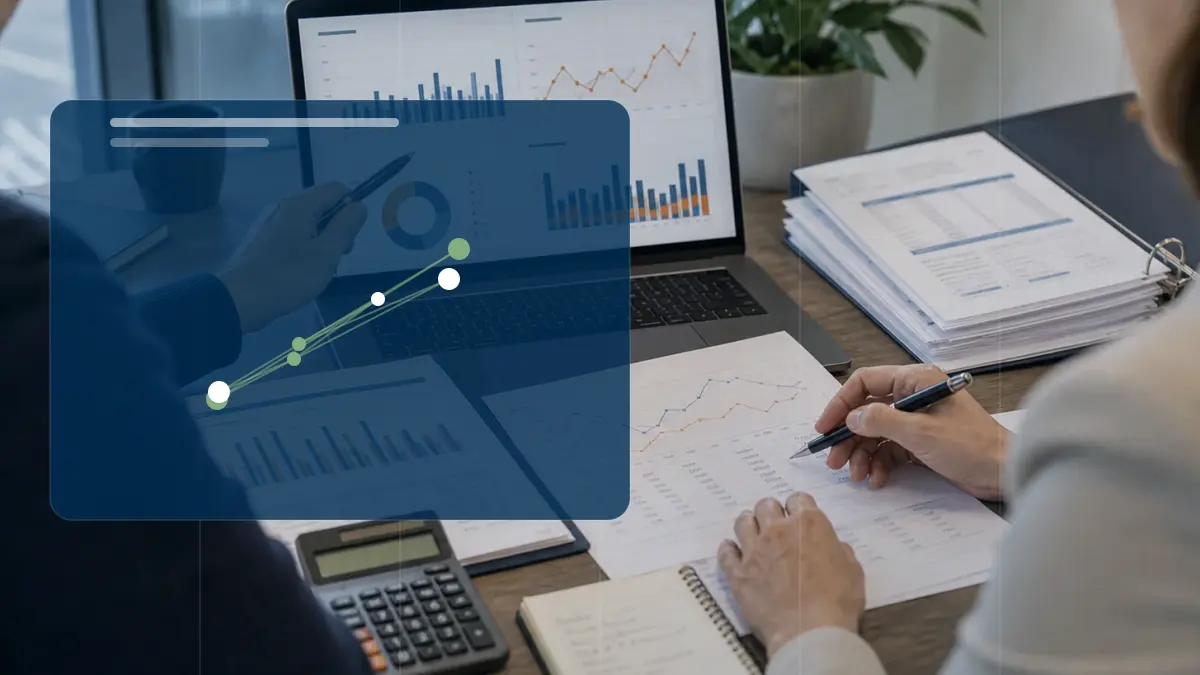
Drawing up an energy procurement strategy for businesses: scattered information versus Energy Intelligence
Many Dutch businesses buy energy by accepting the first reasonable offer when a contract ends. That makes the energy bill a bet on the market at that single moment. For organisations with large or variable consumption this can add up, because prices move sharply. A procurement strategy reverses the order: you decide in advance which risks you accept and which certainty you want. It matters to entrepreneurs, facility managers and finance leads who want a grip on costs and on sustainability.
- Start with insight into your consumption profile, your annual volume, your flexibility and your sustainability goals; that determines which approach fits you.
- Then set your risk appetite and mandate: how much price certainty do you want, and how much room do you leave for market upside.
- Only then choose a contract form or combination, fix your purchasing moments and spreading, and secure the measuring, monitoring and evaluation.
Insight
Traditional approach
Information is scattered across portals, documents, invoices or separate spreadsheets.
Modern approach
Data, context and interpretation are brought together into a clear decision picture.
Decision-making
Traditional approach
Choices are made based on averages, assumptions or occasional analyses.
Modern approach
Scenarios, KPIs and current measurement data make the trade-off more concrete and repeatable.
Follow-up
Traditional approach
Actions often stay non-committal or disappear into separate reports.
Modern approach
Follow-up actions, monitoring and reporting are linked to the same energy data.
Where does a procurement strategy start?
A procurement strategy starts with insight, not with a contract. First map your consumption profile: how much electricity and gas do you use, and when. A production company with a continuous baseload buys differently than an organisation with sharp peaks. Then determine your annual volume, your flexibility and your sustainability goals. If you can shift or temporarily lower consumption, you have more freedom of choice. Next, set your risk appetite and your mandate: how much price certainty do you want, and how much room do you leave for market upside. Record that mandate in writing, so purchasing decisions do not depend on the mood of the day.
- Map your consumption profile: how much you use and at which moments.
- Determine your annual volume, your flexibility and your sustainability goals.
- Set your risk appetite: price certainty versus possible market upside.
- Record the mandate in writing, so decisions do not become reactive.
- Involve finance, operations and sustainability, as the choice touches all three.
How do you translate the strategy into a contract choice?
In a strategy you choose the contract form as the outcome of the earlier steps, not as the starting point. Set your risk appetite alongside the properties of each form: a fixed price gives certainty but no upside when the market falls, while a market-following form reverses that. Then decide not only which form, but in what proportion. Many organisations do not lock everything into one form, but deliberately split their volume: part with certainty, part that moves with the market. Record that split in your plan, so a later choice executes your strategy rather than being a stand-alone decision. You leave the explanation of the individual contract forms to the contract choice itself; your strategy sets the mix and the reasoning.
- Choose the contract form as the outcome of your profile and risk appetite, not upfront.
- Decide the proportion: which part with certainty, which part market-following.
- Record the chosen mix, so every later choice executes your plan.
- Revise the mix when your profile or risk appetite changes significantly.
- Include sustainability as a selection criterion, not as an afterthought.
How do you secure spreading, measuring and sustainability?
A strategy is only complete once you fix when you buy and how you follow it. Determine your purchasing moments and spread your purchases deliberately over time, so you do not lock in your whole volume at a single, unlucky moment. Spreading reduces the risk of poor timing. Then record how you measure: compare your realised price with market averages, track your budget and periodically evaluate whether the strategy still fits. Link procurement to sustainability by weighing your sustainability goals in every choice, through guarantees of origin, a PPA, saving energy or using your flexibility. Revise the plan when your consumption, your risk appetite or the market changes significantly.
- Fix your purchasing moments and spread purchases deliberately over time.
- Measure your realised price against market averages and against your budget.
- Periodically evaluate whether the strategy still fits your situation.
- Weigh sustainability goals through GoOs, a PPA, saving or flexibility.
- Revise the plan on major change in consumption, risk appetite or market.
Curious what this looks like with your own data?
In a no-obligation call, a specialist looks at your meters, sites and energy questions with you. Response within one business day.
Search the knowledge base
Find the answer to your question.
Search using your own words. Abbreviations and spelling variants are recognised, so EMS also finds the articles on energy management systems.
Topic