
How do I manage the energy of my charging hub?
Direct answer
You manage the energy of a charging hub by viewing charging profiles, building consumption, contracted capacity and grid capacity together. Smart charging only works well when it accounts for peaks, occupancy, departure times and energy tariffs.
- Analyse charging profiles
- Limit peak load
- Monitor grid capacity
- Justify smart charging
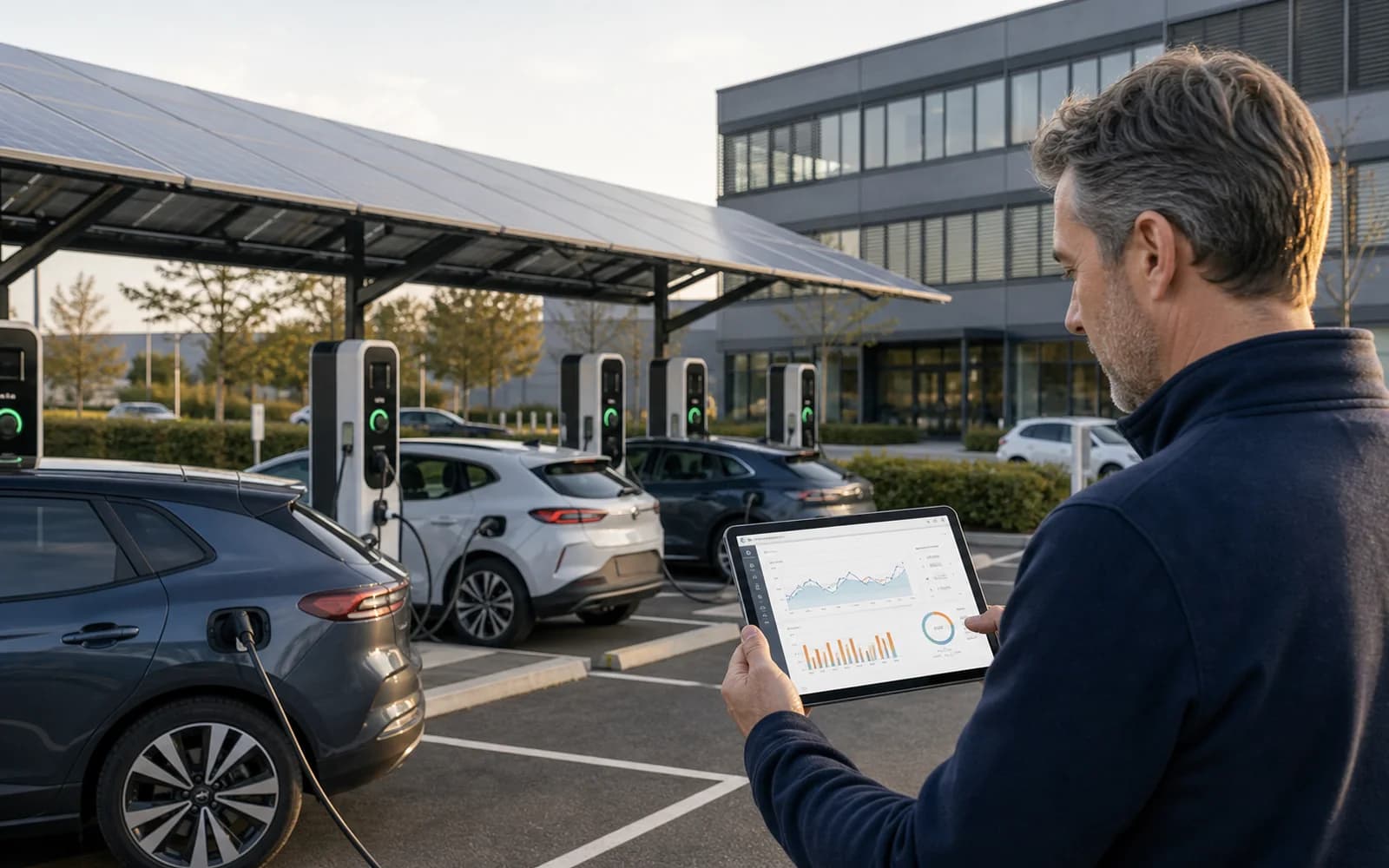
Standalone charging portal versus integrated energy management
A charging hub often looks like a mobility project but quickly becomes an energy question. Additional charging points can cause peaks, consume contract headroom or delay expansion. Charging management must therefore align with the location's overall energy profile.
- Combine charging point data with building consumption and contracted capacity.
- Prevent peaks by distributing charging power dynamically.
- Use energy data to justify expansion, battery or steering.
Scope
Traditional approach
Only charging points and sessions visible.
Modern approach
Charging hub, building consumption and contracted capacity visible together.
Peaks
Traditional approach
Peak problems become clear afterwards.
Modern approach
Peak load is actively monitored and explained.
Expansion
Traditional approach
Capacity demand remains an estimate.
Modern approach
Scenarios for expansion, battery or steering become data-driven.
Which signals should you track?
Simultaneity, peak moments, charging duration, available contract headroom and the overlap with business processes are essential.
- Charging power per time slot.
- Simultaneity between vehicles.
- Building consumption alongside charging consumption.
- Available headroom within contracted capacity.
When does smart charging become relevant?
Smart charging becomes relevant as soon as charging power competes with building consumption or when expansion becomes difficult due to grid capacity.
- Distribute charging power across vehicles.
- Lower peaks during expensive or tight hours.
- Prioritise critical trips.
- Calculate scenarios for growth.
Curious what this looks like with your own data?
In a no-obligation call, a specialist looks at your meters, sites and energy questions with you. Response within one business day.
Search the knowledge base
Find the answer to your question.
Search using your own words. Abbreviations and spelling variants are recognised, so EMS also finds the articles on energy management systems.
Topic