
Dashboard or control
Article 2 of 10 · SMEs, dashboards and controlWhat is the difference between an EMS dashboard and autonomous AI control?
Direct answer
An EMS dashboard makes energy consumption, costs and peaks visible. Autonomous AI control goes further: software takes or recommends actions automatically based on data, rules, forecasts and goals. For many businesses, reliable insight is needed first before autonomous control is sensible or responsible.
- Dashboard shows, AI control acts
- Autonomy requires data quality and rules
- Human control remains important
- Monitoring is often the first step
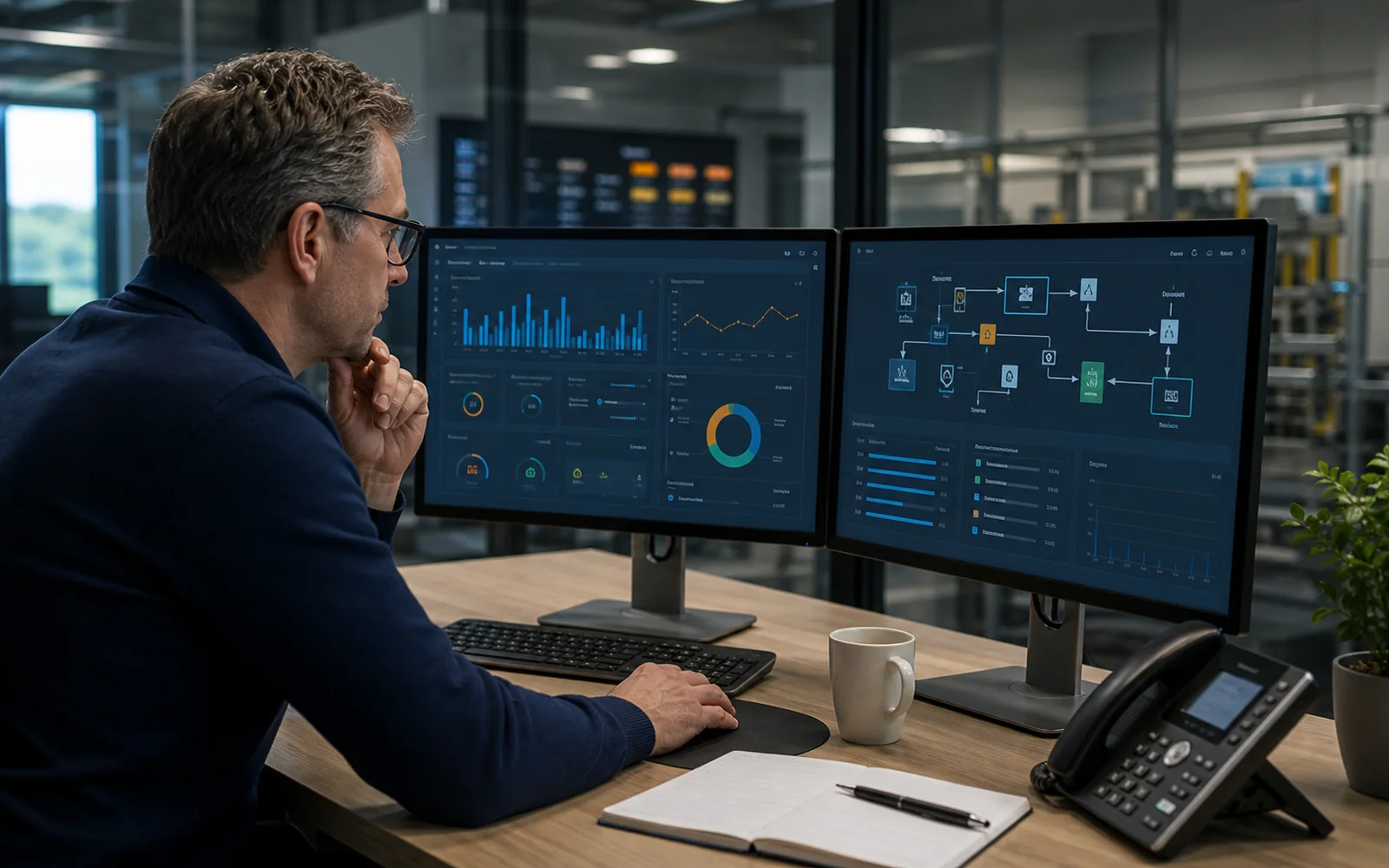
EMS dashboard versus autonomous AI control
The terms EMS, dashboard, AI and autonomous control are often used interchangeably. Yet they are different maturity levels. Someone who only wants to understand consumption needs something other than an organisation that wants to automatically optimise charging infrastructure, batteries, installations or production processes.
- A dashboard helps people decide; autonomous control can influence systems automatically.
- AI control requires good data, clear rules, safety limits and ownership.
- Usually start with monitoring and analysis before letting processes be controlled automatically.
Function
Traditional approach
Give insight into consumption, costs and peaks.
Modern approach
Propose actions or control automatically within limits.
Risk
Traditional approach
Low, mainly information provision.
Modern approach
Higher, because systems or processes can be influenced.
Data requirement
Traditional approach
Measured data and context for analysis.
Modern approach
Reliable real-time data, rules, forecasts and feedback.
Starting point
Traditional approach
Dashboard and reporting.
Modern approach
Control strategy, governance and technical integration.
When is a dashboard enough?
A dashboard is enough when the main question is where consumption, costs or anomalies arise. This applies to many organisations that do not yet have a structured energy data process.
- You want to understand peaks and anomalies.
- Reporting is currently manual or fragmented.
- There is no clear control strategy yet.
- Decisions are made by people.
When does autonomous control become interesting?
Autonomous control becomes more interesting with predictable processes, flexible assets, clear goals and technical connections. Think of charging infrastructure, batteries, CHP, HVAC or production planning.
- Controllable assets are present.
- There is sufficient reliable real-time data.
- There are clear limits for comfort, production or safety.
- The financial incentive is large enough.
Why Energy Intelligence first?
Energy Intelligence helps determine where control can have value. Without insight into profiles and peaks, automatic optimisation is often too early or too risky.
- First measure and explain.
- Then determine priorities and scenarios.
- Only after that explore technical control.
- Retain human control and evaluation.
Curious what this looks like with your own data?
In a no-obligation call, a specialist looks at your meters, sites and energy questions with you. Response within one business day.
Search the knowledge base
Find the answer to your question.
Search using your own words. Abbreviations and spelling variants are recognised, so EMS also finds the articles on energy management systems.
Topic